
October is a great month for spooky reading! I decided to pass on our online book club’s selection this month, Dracula, as I’ve already read it many, many times. Instead, it seemed like a great opportunity to finally tackle The Philosophy of Horror, by Noël Carroll. And naturally, once I got into it, I found myself making connections to political psychology, but I’ll get there in a bit.
For “horror,” Carroll has a rather narrow focus. He dismisses literature focused on the uncanny as mere “tales of dread” (p.42) that illustrate the possibility that the universe is run by inexplicable forces. He also dismisses Edgar Allen Poe as “terror, not horror.” Instead, he’s interested in monsters. He defines “monster,” which I’ll also return to shortly, then he devotes a chapter to a philosophical analysis of why we have an emotional reaction to horror movies, which makes a lot of sense while also not referencing any of the many works on emotional reactions to fiction that I’ve come across in narrative psychology.
One interesting part is Carroll’s analysis of plot. He describes a classic four-element plot of many horror stories: the onset of the problem or arrival of the monster, the discovery of the monster, the need to confirm the presence of the monster in the eyes of skeptical authority figures, and the confrontation with the monster. Many horror stories contain all four elements, and every subset of them has been used in horror fiction.
Another classic horror plot is the overreach, in which someone conducts a scientific or magical experiment involving forbidden knowledge. Here there are also four elements: preparation for the experiment, the experiment itself, the discovery of evidence that the experiment has boomeranged and produced a monster, and the confrontation with the monster. It’s interesting that both types of horror stories are about knowledge – in the first, we’re shocked out of our complacency by discovering that our understanding of the world is inadequate, and in the second, someone deliberately tries to learn more than one should.
Another topic Carroll explores in depth is why, if monsters are so terrifying and/or repulsive, would we choose to subject ourselves to the experience of spending time with them? Aside from the adolescent rite of passage that involves seeing how much gore we can tolerate (which he attributes to boys, but *ahem* I went through that stage too), he comes up with an interesting theory. In horror, he says, strange and unexpected things command our attention and engage our curiosity in ways that are sustained throughout the work.
I did have some head-scratching moments while reading the book. For one thing, he refers to the costume for Chewbacca, the Star Wars Wookiee, as a “wolf outfit” (p.16). (What???)
For another thing, on page 56 he talks about the rise of early Gothic horror literature as a reaction against the rationalism of the Enlightenment movement, as if he’d come to that conclusion entirely on his own, without any mention of Romanticism, the well-known reaction to the Enlightenment that was prominent in literature, visual art, and music, and that inspired the “volk” mentality that was so fundamental to nationalist movements in Europe and elsewhere. (If you’re interested, see my previous posts on Mary Shelley and the Schumanns.) He does make the point, however, that the same curiosity, discovery, and rational problem-solving found in horror fiction are similar to the process and methods of the Enlightenment project of science.
A third oddness is his assertion (p.192) that the target audience for my beloved Jason and the Argonauts is the same as for An American Werewolf in London. I must beg to differ.
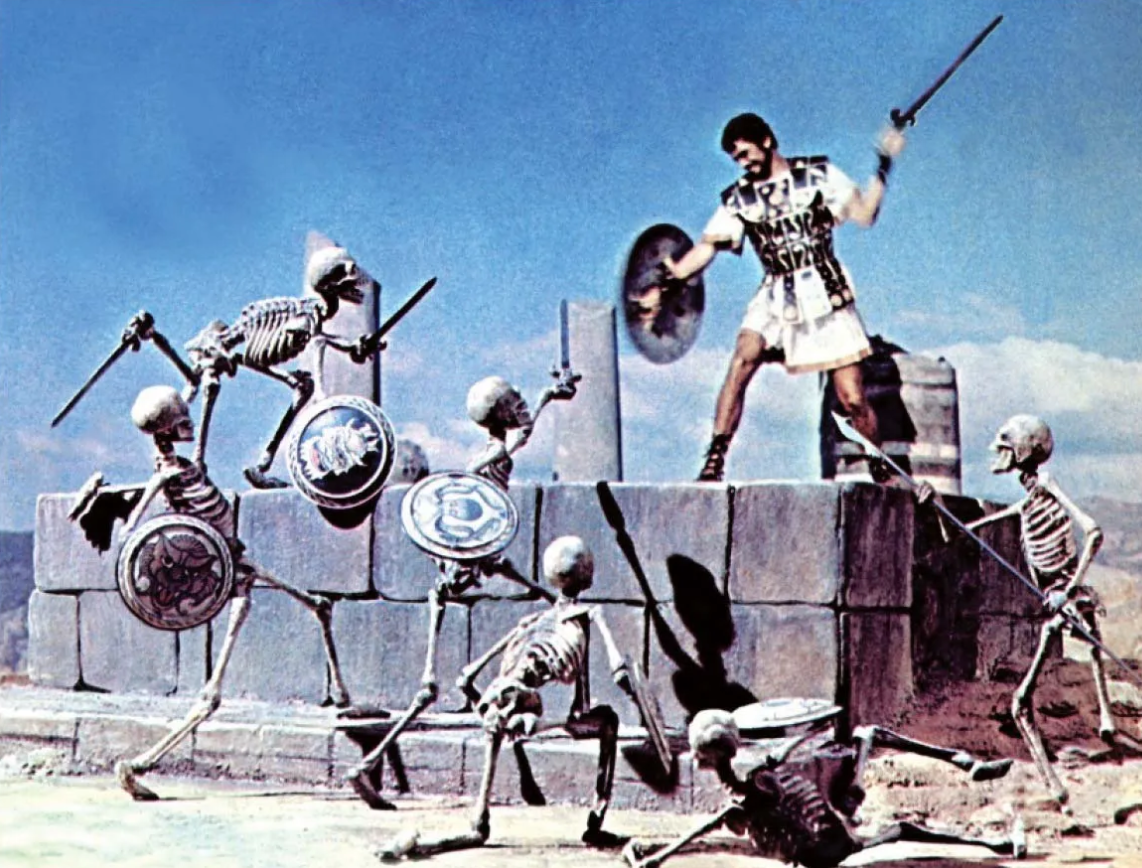
Anyway, back to the monsters. In Carroll’s definition, a monster must be threatening and also must violate our understanding of the basic categories we use to understand the order of the world. This can happen in several ways. Two mutually exclusive categories can be fused together, for example, living + dead = “undead,” like vampires and zombies. Or, two mutually exclusive categories can exist in the same person, but at different times, like wolf + human = werewolf. Or the same person can exist in multiple places, like a doppelganger. In each of these cases, he tells us, this category violation produces “impurity,” in the sense Mary Douglas refers to in her classic book, Purity and Danger, and (he says) impurity leads to disgust and revulsion. Another type of violation has to do with scale – something already creepy could be magnified into a much larger form (like giant ants) or could be collected into a much larger mass (like a flood of ants).
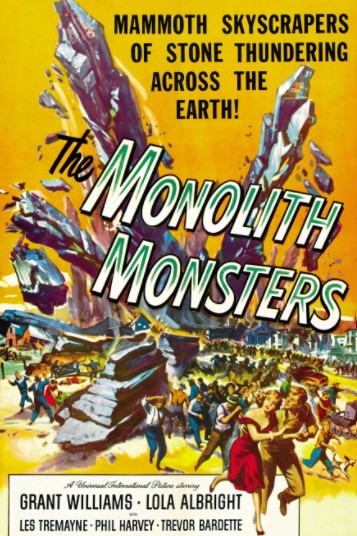
(Carroll’s definition doesn’t quite fit one of my old favorites, the 1957 flick The Monolith Monsters, in which fragments from a meteorite turn into gigantic monoliths that then shatter and start the process again, meanwhile draining all the silicon from everything they touch. Threatening, yes, and certainly category-violating, but not exactly repulsive.)
(Also, his equation of “categorically impossible” with “disgusting” and “repulsive” is a misreading of Mary Douglas’s Purity and Danger. Although some scholars have linked impurity and disgust, that’s not what Douglas was doing. Rather, she tells us that such category violations are potentially powerful, psychologically, which can give them a major role in religion, and which can feel problematic (sometimes “matter out of place” = dirt). Beyond what Douglas had to say on the topic, one glaringly obvious example is Jesus. The idea that he could be both God and human caused considerable consternation to those among the early Christians who were philosophically minded – centuries of argument ensued – but none of them ever concluded that Jesus was in any way disgusting or repulsive.)
The “threatening and impure” themes in Carroll’s book then reminded me of the work I did in grad school with Gerard Saucier, where we studied the use of language to justify treating “out-group” members as worthy of mass slaughter. In other words, it’s dehumanization to encourage genocide. We studied numerous categories of mass violence, from ethnic cleansing and conflicts of religion or belief systems to settler colonialism and callous mistreatment of indigenous people. When the in-group felt the out-group was threatening (being the “wrong” ethnicity or religion or aligning with the wrong belief system), they were often targeted for elimination. When the in-group felt the out-group was less than human, however, they could carelessly be used as tools or slaves (as in the rubber harvesting program in the Belgian Congo or the Mexican peonage system), or they could be forcibly relocated (as in the U.S. Trail of Tears), and if they didn’t survive, no big deal. Those that were threatening and didn’t fit into the supposedly proper category (like being the “wrong” ethnicity for the country) could be treated as monsters, a frightening problem to be solved. The list of metaphors for describing out-group members that I collected as part of the project illustrates this clearly: demons, cockroaches, murderous vultures, worms, savages, food for dogs, dangerous microbes, invasive germs, pigs, bloodsuckers, spiders, vampires, weeds, filth, maggots, abscesses, parasites, trash, swarms of insects. Every one of those is a good candidate for horror, with the possible exception of weeds. (Although if you’ve ever seen the blackberry vines in my part of town…)
In the United States, as we all know, we’re currently experiencing serious polarization, which on the one side has been deliberately cultivated by leaders and their favorite media, and which on the other side has reflected a great deal of shock and consternation that our neighbors could think like that. Each side sees the other as problematic, and it can be very easy to dismiss the others and try not to have to deal with them. We aren’t quite at the point of dehumanization, I hope, at least not for most of us, but the divides can be painful.
While I was reading Carroll’s The Philosophy of Horror, I was also still reading Steve Ellerhoff’s Jung and Star Wars, which I wrote about in my last post. I came across a very useful quote on page 174. The context was very different (the life of Luke Skywalker), but I think it applies to our situation too. Ellerhoff quotes Donald Kalsched: “[This] is our work – finding the humanity in the ‘enemy,’ even if the enemy has been possessed by evil.” Our fellow Americans are, I hope, not “possessed by evil,” but many make the case that those on the opposite side of our political divide have been seriously deluded. With this quote we can remind ourselves to keep recognizing their humanity, not reducing them to “threats” or “lesser” than ourselves.
And as the children show up on our doorsteps tonight, some of them playing at being monsters, let us remind ourselves that the original point of Halloween was the permeability of boundaries between sharp binaries – overcoming those rules tied to categories. With Halloween, historically, the binary was life and death, but let’s extend that, if we can, to “us” and “them.”

 The Meta-Narrator