
One of my favorite things is making fun connections between the things I’m watching and reading, and this past week has been great for that. I’ll start with Brigands & Breadknives, the third in a series by Travis Baldree. His first book was a sensation when it came out in 2022: Legends & Lattes, set in a world that, like Dungeons & Dragons, is filled with people of all sorts of fantasy species. Viv, an orc, had had enough of adventuring and decided the thing to do was to move to a new city and set up a coffee shop. The locals weren’t familiar with coffee, but a shy little rat-person baker invented cinnamon rolls, and the new coffee shop was a success.
The second book continued the cozy fantasy theme – we learned that earlier in Viv’s adventuring career, she was injured and had to stay in a small seaside town while recovering, and she became great friends with another little rat-person, Fern, a bookseller. At the end of this second book, Bookshops & Bonedust, Fern had decided to relocate her bookstore to the city, beside the coffee house. Now, in the third book, Fern has her own adventure alongside a legendary elf warrior named Astryx and a delightfully bonkers chaos-goblin. Here they are:

So… speaking of booksellers having adventures, I’m now somewhere in the middle of the massive 12-hour Ken Burns documentary of The American Revolution, and so far my favorite story was in part two, the relief of Boston. Early in 1776, before the signing of the Declaration, the British had occupied Boston, which had become too unruly with the Tea Party and all that. One Boston bookseller was helping the colonists set up their fortifications outside the city, in the hope the British could be driven away.
Our bookseller was not a soldier himself, but had read all about it – he was something of an artillery expert, based solely on book-learning, and when George Washington showed up, this looked like a great opportunity. He sent the bookseller, along with some assistants, up to Fort Ticonderoga, New York, more than 200 miles away, to assess the equipment the colonists had taken in an earlier battle and bring back what they could. So off they went. They found the cannons, etc., loaded them up onto carts, and made their way back to Boston, stopping at inns along the way for encouragement and cider, and soon our bookseller was reporting to Washington: “I’ve brought you 50 cannons, ready for your use!” Washington was delighted, and next thing you know, our bookseller, Henry Knox, was in charge of the rebel artillery. He would become the first U.S. secretary of war, and Fort Knox is named for him. Reading pays off!
But “adventuring bookseller” wasn’t my first mental connection with Brigands & Breadknives – it was that one-eared elf, Astryx. She’s over a thousand years old and has been wandering the countryside as a bounty-hunter for most of them. And this summer I had been spending time with another wandering elf, who also lives in a world full of fantasy species: the wizard Frieren. She’s also more than a thousand years old and also spends her time wandering the forests, but in her case she’s doing magical research, not engaging in gratuitous combat. She did have what we would call an “adventure” once, though. Some 60 years ago, she set out with two humans and a dwarf to liberate the lands from a Demon-King.

They did so, after a ten-year quest, but ten years was nothing for her, and she didn’t give them much more thought before promising to meet again 50 years later. As our story begins, she does meet up with her adventuring party again – but the leader, Himmel, is very old and near death. After he dies, she suddenly realizes with regret that she barely knew him. She decides to retrace the steps of their ten-year adventure and perhaps learn to make peace with the fleeting nature of human life. (And just like Astryx, she gets to know a woman named Fern!)
Frieren: Beyond Journey’s End is a 28-episode anime series, and season 2 will come out in January. It’s gorgeous and unusually thoughtful, and after the first few nostalgic episodes there’s also plenty of humor. Highly recommended!
So I was thinking about Frieren and Astryx, two elvish women leading long and mostly solitary lives – there don’t seem to be many other elves, but there are plenty of humans, dwarves, etc., in their worlds. What would it be like if we had people like that with us today – people who, say, had been in Britain before William the Conqueror did his conquering, or in China when its people were first inventing gunpowder and the magnetic compass, or who were personally familiar with the might of the Ghana Empire? What could they tell us? Could they even relate to us at all?
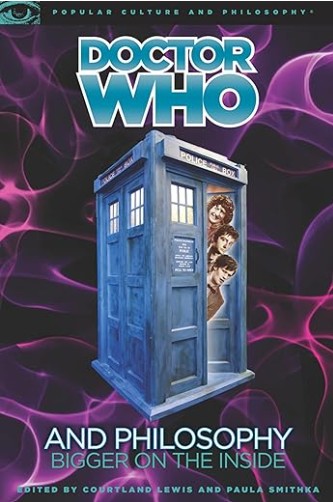
And then I suddenly remembered a paper I’d written on a very similar topic – the life of the title character in Doctor Who. My paper, published as a chapter in the 2010 book Doctor Who and Philosophy: Bigger on the Inside, addressed this very situation. The Doctor (a timelord from the planet Gallifrey) has lived for at least 900 years (the Internet currently thinks about 4000 years, actually), and although he (or she) travels through space and time, the Doctor’s lifestyle is very much like that of Astryx or Frieren. How can the Doctor possibly relate to ordinary humans? In my paper, I propose that that’s the very purpose of the Doctor’s long series of “companions” – through empathy with their perspectives, the Doctor’s sense of wonder is continually renewed. Through their eyes, this timelord regularly gets a fresh view of the universe.
(Ooh, all at once I’ve made another connection! In Scott Slovic’s Going Away to Think, which I finished reading just a couple of days ago, he writes that travel is a way “to force one’s mind to create new maps of meaning. The mind thus destabilized and invigorated tends to see through established structures and patterns, even upon returning home.” In other words, it reinforces the psychological trait of Openness, which gives us the flexibility to respond and thrive in new and strange situations, one of the most useful of all human traits.)
I can’t help but think that if our own lifespans were in the thousands of years, climate change wouldn’t be mysterious. We’d all be personally familiar with it. As it is, we’re not set up to experience something slow-moving as a crisis – our bodies and brains don’t work that way.
And that brings me to the last show I wanted to mention, Sacred Planet with Gulnaz Khan, a four-part PBS series, which you can watch online. Each episode shows us how a people are experiencing climate change, as witnessed by their own records and illustrated through their spiritual practices. The first episode was about the Arhuaco people of Colombia, who consider themselves our elder brothers, bearing witness to environmental changes made through our collective actions. In the second, we see the Sahara encroaching on communities in western Africa, where Muslims and Christians have been working together to save their villages. The third takes us to Lake Suwa in Japan, where Shinto temples have kept records of a mysterious winter phenomenon, the sounds of the frozen lake, which now happens much less frequently than in the past. Japan’s Buddhist temples have been promoting a method of creating green (thick, rapid-growing forest) barriers to protect the coastline from devastation by tsunamis. In the last episode, which I’m still watching, indigenous people in Peru have long cherished their local glaciers, through rites now integrated into their practice of Catholicism, but those glaciers are disappearing.
We may not have thousand-year-old people, but we do have many very long-lived communities, and some of these communities are doing what they can to alert the rest of us to the problems caused by careless industrialization. Like Astryx and Frieren, though, they’ve largely been marginalized. Thanks to Ms. Khan and PBS, we can learn about them – and, I hope, learn from them too.

 The Meta-Narrator