Inside or outside the box?

Getting dressed for Halloween is a challenge, when one hasn’t planned in advance. I’d been thinking of revisiting my identity as Cecil Featherstone, Professor of Morbid Poetry, who spends the day reciting the various death-themed poems I memorized as a teen, but I didn’t get around to buying a tweed jacket. Instead, I ended up with cats’ ears plus my “I Like to Think Inside the Box” t-shirt.

And that brings me to my topic for today, that “box.” No, not the coffin from my t-shirt, but that metaphorical box that we try to transcend when we’re being creative – our routines, habits, ordinary and expected ways of doing things and seeing the world.

I was recently reading a very interesting 1964 book by Arthur Koestler: The Act of Creation. Koestler sees intriguing similarities between humor, scientific discovery, and art. With humor, there’s a clash between the rules governing two contexts – we value “thinking outside the box” but skeletons belong inside their “boxes.”

Science (at least the new discoveries part) and art also involve two contexts. We start by mastering the usual rules and expectations for our field, and then – typically inspired by a second context – we may get new insights. Astronomy was limited by geometry for a very long time, until Kepler realized that physics, like the laws of gravity, could teach us even more.

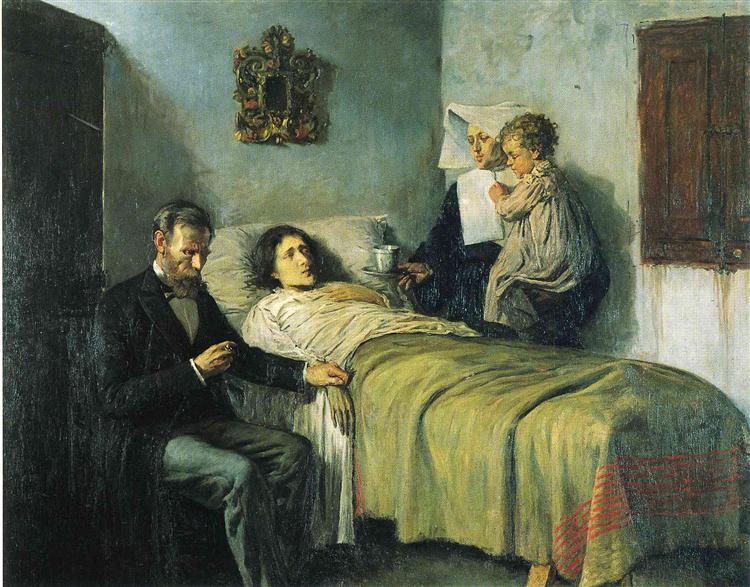
Pablo Picasso, considered one of the greatest artists of modern times, started by totally mastering the practices of representational art. Here’s an example. Realistic, right?

Once he had thoroughly learned all the rules and expectations of art-as-it-was, he could play with those rules to convey his understanding of a very different context:

Now Picasso is violating convention and showing us the horror of chaos – the fascist slaughter of the village of Guernica. The government of Spain had violated all the rules of supposedly civilized warfare and invited its ally, Nazi Germany, to bomb this village and teach the Spanish people not to question the government’s power.

In other words, Picasso creatively violated the rules of one context to show us what can happen when governments violate the rules in another.

Order… and chaos. In our personal lives, we need a balance. We want many things to be predictable, because it saves us time and effort and lets us better cope with things that are unpredictable. That’s why we have routines. Steve Jobs famously wore basically the same outfit every day – it saved him time and thought. I eat basically the same meals most days – it’s faster and easier. But that’s my personal choice. I’m always free to just order a pizza instead. And then with that time and energy we’ve saved, ideally we’re ready to be creative, bringing together different contexts for new insights.

When we’re thinking about the bigger picture, though, we value order. We need things to be predictable – we want our supermarket shelves to be stocked, our flights to be on time, and our government to follow the laws that our representatives have agreed to, and to work within normal channels in conventional ways. There’s already plenty of chaos – hurricanes, terrorism, war, wildfires.

One of our presidential candidates is clearly in favor of even more chaos. As Heather Cox Richardson put it yesterday, “Ending a campaign with a promise to crash a booming economy and end the Affordable Care Act, which ended insurance companies’ ability to reject people with preexisting conditions, is an unusual strategy.”

Meanwhile, we’ve got Vladimir Putin funding chaos in our information system – telling people who don’t know any better things like “Kamala is a godless heathen” and “Trump’s tariff idea won’t dramatically raise prices.”

I’ve written elsewhere about the value of small-c conservatism, expecting things to work a certain way and hoping things won’t change. Building on that, here are my points for today, the day I turned in our family’s ballots for the 2024 general election:

It is actually more small-c conservative to choose a leader who values order.

It is actually more small-c conservative to go with the party that recognizes actual risks and plans to address them proactively, like climate change. If you don’t like immigration now, just imagine what it would be like if Bangladesh, a nation of 170 million people, was submerged by water.

And above all, whether we want things to be comfortable and familiar or whether we’d rather shake things up, we need systems that give us a place for us to have our say – and that means we need leaders who respect the rule of law.

Posted in US politics | Tagged , , , , | Leave a comment

Doomed to keep learning the same lessons?

So there’s this novel. I haven’t read it myself, so it wouldn’t be fair for me to identify it – but it was written by an Oregon-born author, published in 2020, became a best-seller, and won awards. Many people love it, including at least one of my friends, and others really don’t care for it, including many members of my husband’s book club, a generally fine group of people. It’s about embracing diversity, and since it’s a fantasy novel, I bet that theme gets pretty interesting.

My husband and I had a long discussion about the book this week. I was hoping he could help me see why some people might love it while others, who do value its themes, didn’t enjoy it at all.

For him, it came down to the story’s logic. The main character is great because he has all of these desirable qualities, but then he’s plunged into a situation where he has to develop these same desirable qualities, as if he didn’t already have them. Another character does likewise – starts great but then has to go through a process to become great. That’s inconsistent!

I agree, but I kept thinking about it. Now I’m wondering – and this is sheer speculation, because as I said, I haven’t read this book – if maybe the conflict is between cyclical and linear time. The people who share my husband’s complaint might prefer a linear way of experiencing the world, where cause leads to effect and these effects accumulate and grow. That’s normal and common sense, right?

In a more cyclical way of experiencing the world, however, things may be eternally true and yet need to be developed and experienced again and again. Let me give two examples that I hope will expand your sympathy toward cyclical thinking, if you’re skeptical.

When we celebrate our annual holidays, each year we touch base with old truths (the emotional heart of the holiday) in new contexts (where we are in life right now). We carry our memories of our earlier holidays with us, but we also get to do things fresh and new each time we celebrate – the new experiences and the memories resonate together. We go through cycles of experiencing “eternal truths” in new ways.

In the writings of Mircea Eliade, a Romanian historian of religions, all ancient religions worked this way, with eternal truths that new generations of people would be born into and experience. Only Judaism and its offshoots, Christianity and Islam, are more linear, where societies are building toward a future.

A second way that cyclical thinking comes in handy is when we understand that societies that haven’t experienced a particular bad outcome are less likely to heed its warning signs. With new generations, we find ourselves re-experiencing some of the same old patterns and not necessarily noticing or caring. It is an eternal truth that totalitarianism is bad, whether that’s Stalinist communism or Hitler and Mussolini’s fascism, but people who aren’t attuned to its signals may be vulnerable to its lies.

So where many of us hope that we have collectively learned to Run! Run! Run! from a man using language like “vermin” to describe people living among us, others see a tough leader standing up to problems on our behalf. It could be tempting to trust someone like that.

Over the last few months, I’ve been reading key works in a variety of fields beyond my own and finding more examples to add to my book manuscript on the ways we use language to shape public opinion. If you’d like to read more about the topic right now, though, I’d suggest the paper that Gerard Saucier and I wrote a few years ago. “Vermin” and words like it have been used to soften people up toward the idea of committing genocide.

As the philosopher George Santayana told us more than a hundred years ago, “Those who cannot remember the past are condemned to repeat it.” You can’t get more cyclical than that.

For fans of this book, then, maybe the eternal truths it celebrates are not diminished by the reminder that they may need to be relearned. For the real-world usefulness of this idea, though, let us hope that whatever lessons we collectively need to review aren’t put to too great a test this November.

Posted in narrative science | Tagged , , | Leave a comment

Momentary treasures

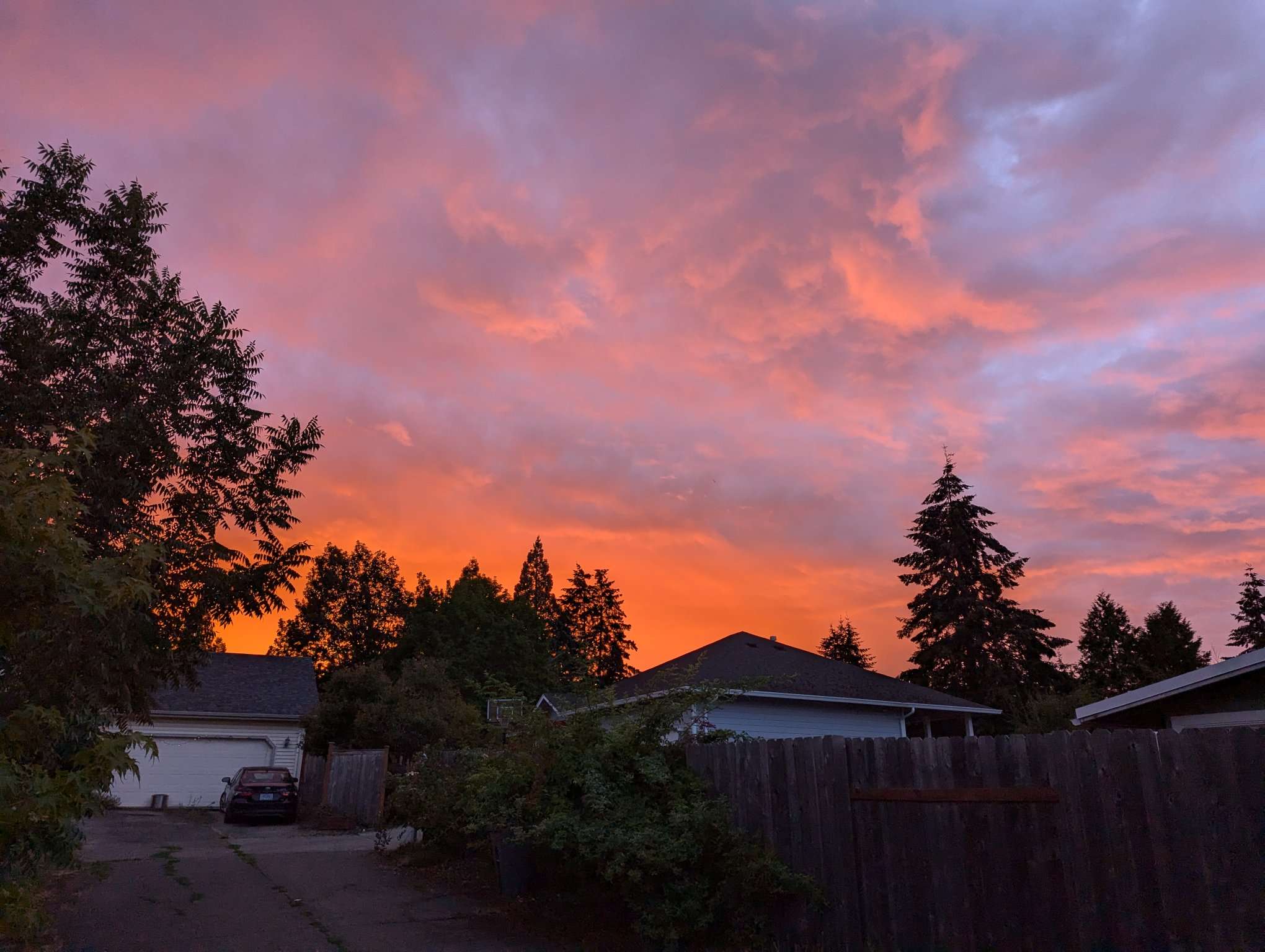
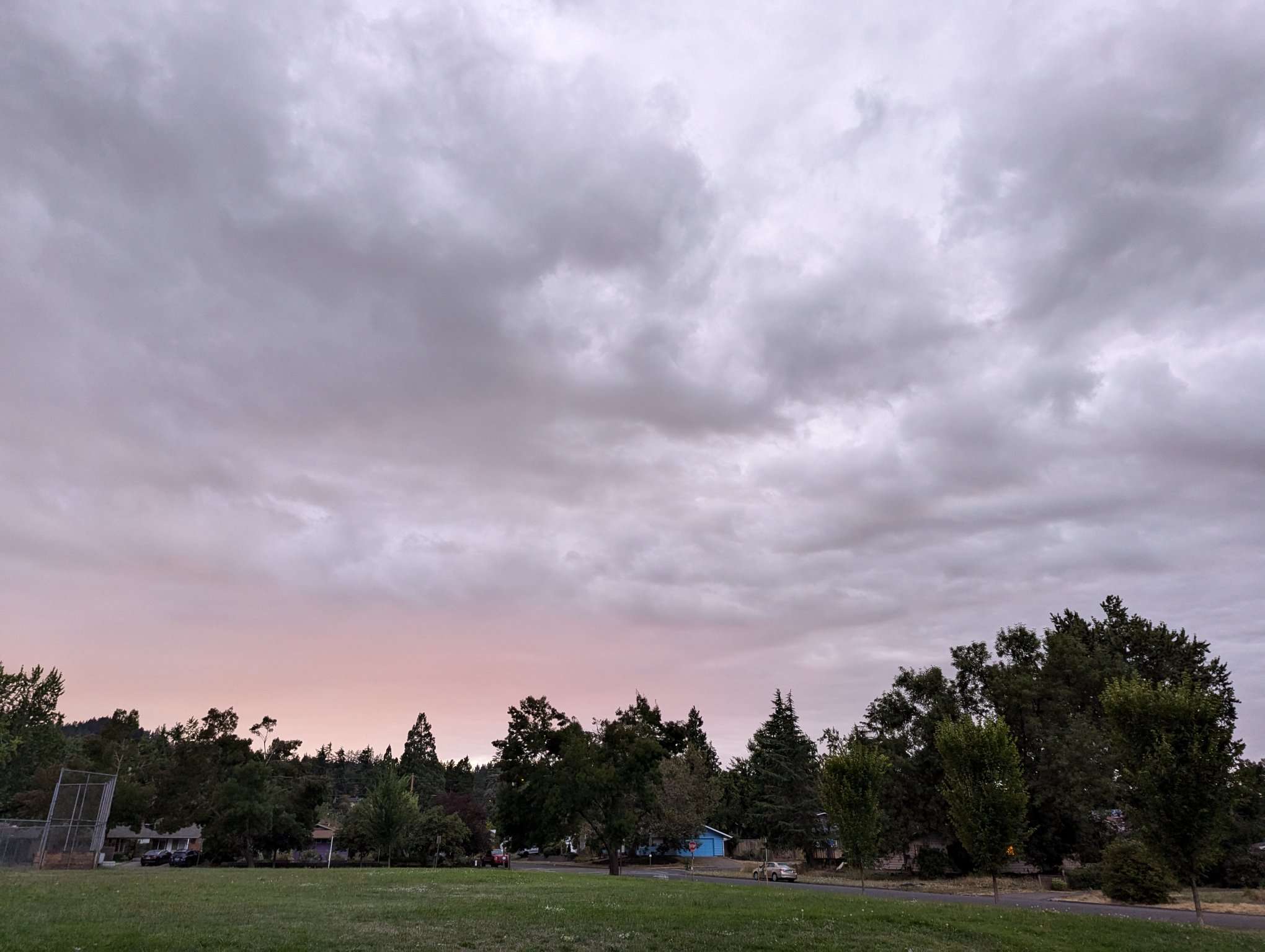
The first time I tried going on a walk this evening, I discovered it was starting to rain, so I went back inside for a bit. I’m glad I did, because the next time I tried, I found this:

Wow! I wished I could teleport to the neighborhood school for a better view – I knew I couldn’t possibly walk or even drive there in time. Or better yet, the western Ridgeline trailhead on Blanton Road, which looks westward toward the Coast Range, with the reservoir sparkling at its foot.

As it was, by the time I got to the school, the sky looked more like this:

Oh well. Sunsets are ephemeral wonders, although many of us try to capture them with our cameras – at least four other neighbors were doing so, just like me.

The treasures of the moment – such beauty in the world. Sometimes the event itself is transient, like a sunset, the blooming of wildflowers, a live musical performance. At other times, the event is available for quite a long time – but not forever – and it’s our own presence there that’s momentary.

Recently I was reading a book by Kenneth Burke, an expert on rhetoric and narrative, and I was surprised to learn that he was the grandfather of Harry Chapin. Remember his song, “Cat’s in the Cradle”? The song’s storyteller learns the hard way that if he doesn’t focus on the beauty right before him, he may not get a second chance.

The ephemeral is one of the main ways we can experience awe and wonder – its opposite is the vast and overwhelming. As I’ve explained elsewhere, I don’t think of awe and wonder as synonyms. “Awe” is something that grabs and focuses our attention in such a way that we can’t even think, and it’s not necessarily good. Some people (like me) love aerial fireworks, and others find them distressing.

Wonder is more delicate, it draws us in – it’s often pretty or interesting, like a rainbow. Wonder can engage our imaginations… “I wonder why…” “I wonder whether…” Many have noted that wonder can go hand in hand with scientific thinking.

I suppose we could say that awe is “Wow!” or “Whoa!” while wonder is more “Ooooh…”

When I’m enjoying the sunset, I usually focus on how great it is right at that moment, which is a positive experience, but it’s also possible to focus on the bittersweet transience of it all. It’s my understanding that that’s the classic emotional experience behind the Japanese cherry blossom festival – every falling petal reminds us that the beauty cannot last.

Another emotion associated with the ephemeral is surprise, which can definitely be fun. Yesterday’s thunderstorm covered my lawn with hail – in August! – and I rushed to the front door to see. While I was out there, though, there was a clap of thunder pretty much directly overhead, which utterly overwhelmed my ears and shook the roof of my house. My son was in the kitchen, and the two of us started cracking up with laughter.

We humans are very much attuned to noticing the unexpected. Our cats didn’t care about the thunder one bit (although a strange light can definitely excite them). I have to say they probably didn’t notice the sunset either. But I’m glad that I did.

Posted in salience markers | Tagged , , , | 4 Comments

The problem with STAR Voting

I’ll admit it – when the woman stopped me outside the library a few months ago to get my signature to add “STAR Voting” to our local ballot, I was enthusiastic. STAR Voting is a system where, instead of casting your vote for one candidate, you get to rate them all. Then, for the two highest-rated candidates, a second look at the ballots sees which of those two was favored by each of the voters, and they’re the winner. It’s a system that, according to its promoters, supports “More Voter Choice – Vote Your Conscience! – Never Waste Your Vote!” Mark Frohnmayer has written up a thorough explanation in favor of STAR Voting, here.

On Mother’s Day, though, when we sat down to vote (Oregon is 100% vote-by-mail), my husband was definitely not in favor. He’s a math guy who’s experimented with lots of voting systems, and he immediately saw a problem. The advocates of STAR Voting think that people will vote with their true preferences, but they’re expecting a rather measured voter mentality – and STAR Voting favors a more extremist temperament. So I gave it some more thought.

Let’s imagine an election with three candidates. (In an election with two candidates, STAR Voting is just a more complicated version of what we’ve got right now, so we need at least three to show its flaws.) In our imaginary election, let’s suppose that the Red party has one candidate, and although the majority doesn’t want him, those who do are very enthusiastic and hate the other two.

The Blue party has two candidates, and normally the stronger candidate would get almost all of the Blue votes, but let’s suppose the weaker candidate’s fans are excited about STAR Voting and want to show their support for their candidate, assuming the stronger candidate will win in the second round.

Let’s name the Red candidate Trump, the stronger Blue candidate Biden, and the weaker Blue candidate RFK-Jr. And just to make things simple, let’s pretend we have ten voters, but of course this is all basically the same if we scale it up to an actual voting population.

Of our ten voters, there are three who are enthusiastic for Trump. They rate him as 5, and they rate Biden and RFK-Jr as 0.

We also have three RFK-Jr fans. They rate him as 5, and they rate Biden and Trump as 0. Why do they rate Biden as 0, even though they prefer him to Trump? Because they’ve got caught up in the extremist rhetoric and think a “0” is the right thing to do. (STAR Voting incentivizes trashing the opposition, as we’ll see.)

Now let’s suppose that Biden’s four supporters are taking a more measured approach. Sure, they favor Biden, but they don’t buy into extremism, so they rate him as 3. They rate the other two as 0 because they simply don’t want them.

Normally, we’d have three votes each for Trump and RFK-Jr, and four for Biden, even if the RFK-Jr fans don’t remember that they’re really Blue party members who, under the usual voting system, would typically vote for Biden too. Even without them, Biden has the most supporters, so Biden wins.

With the STAR Voting, though, we now have 15 points each for Trump and RFK-Jr (since they each have three people scoring them as “5”), and 12 points for Biden (four people scoring him as “3”). Only Trump and RFK-Jr go on to the second round, and they’re tied (the downside to having only 10 voters).

But suppose one of those measured-temperament Biden voters thinks, “Ugh, I really don’t want Trump or RFK-Jr, but RFK-Jr isn’t as bad as Trump, so I’ll rate him as “1” on my 0-5 scale and keep Trump as “0”. Guess what? Now RFK-Jr is the winner.

My husband points out that this argument still assumes that all of the voters are being sincere. In this era, though, that’s not something we can take for granted. If the Trump voters really dislike Biden, they could campaign to have their supporters give “5”s to Trump and “4”s to RFK-Jr, such that a majority giving “3”s to Biden end up being outscored anyway, even without a competitive number of RFK-Jr supporters. So the STAR system encourages “strategic” voting too.

I read online today that STAR Voting has failed this time, but of course its creators and backers will keep trying. I hope they’ll take into account, though, that voters do have different temperaments.

STAR Voting measures enthusiasm, and enthusiasm can be manufactured.

And as my son put it when we were casting our ballots on Mother’s Day, people who think in more measured terms are generally more trustworthy. We want our voting system to support that, not to undermine it with incentives for extremism.

Posted in US politics | Tagged , | Leave a comment

To create “small pockets of flourishing”

This month, the Oregon Bach Festival book club’s reading project combines two of my special interests: music and nature writing. We’ve been listening to Sarah Kirkland Snider’s “Mass for the Endangered,” which the Oregon Bach Festival is going to perform on June 30, and we’ve been reading a book by Oregon author Kathleen Dean Moore, Earth’s Wild Music: Celebrating and Defending the Songs of the Natural World.

Kathleen Dean Moore is one of my favorite nature writers. She’s an environmental philosopher, and since she lives just 40 miles or so north of me, she’s often writing about my own ecosystem. Her writing is simply beautiful.

I consider Moore’s writings to be classic examples of “earnest” environmental literature. Scott Slovic, a world expert on nature writing (and, disclaimer, now my work colleague), has written about the distinction between “earnest” writing, where the author says what they mean directly, and more “ironic” literature, where the point is often made indirectly, often with humor. And then, within “earnest” writing, he’s described two categories very commonly found in environmental literature, the “rhapsody” and the “jeremiad.” A rhapsody draws us in with awe and wonder, the beautiful and the sublime – and then a jeremiad hits us with a looming or ongoing disaster.

In one of his papers, Slovic explained that, especially in the earlier decades of environmental literature, it was important to authors not to scare away their public. They would have to be very careful about the ratio of beauty and doom. Sometimes writers would have their whole book focus on describing the amazing qualities of their topic, with only a few sentences of concern. At other times, like with Rachel Carson’s Silent Spring, she had already created a large audience for her work with two books purely on natural wonders, and then she was able to bring that audience with her for her book on the disasters of profligate pesticide use. (I’ll note that Carson did pepper Silent Spring with moments of sarcasm, which made it all the more readable.)

Now, however, as author Nicole Seymour explains in her book Bad Environmentalism: Irony and Irreverence in the Ecological Age, people are reacting to decades of such writing. The earnest style has become alienating for many. It’s as if the rhapsodies and jeremiads have created a group of insiders who appreciate them, but also outsiders who don’t particularly care about nature, and to whom these styles look too much like religion.

I have to say, it can be very jarring to read Kathleen Dean Moore after reading Nicole Seymour.

However, in one of the essays we read in the book club for this past week, Moore addresses the question of, “What are we supposed to do? What is there to hope for at the end of this time? Why bother trying to patch up the world while so many others seem intent on wrecking it?”

Continue reading

Posted in environmental thought | Tagged , , , , | Leave a comment

Immersed? or transported?

My favorite memory from high school chess club was the time I played against a guy I’ll call Fred, the top player at a small-town high school about 20 miles west of us. I was normally our #2 player, but our #1 player wasn’t available that night, so this was my one and only chance to show what I could do against another school’s very best.

“Fred” and I had been in a college math class together the previous summer, although we sat on opposite sides of the room, so I knew who he was, and I was happy to see him again. He had a buddy with him, though, who was watching him play, and they kept making sarcastic comments to each other about how embarrassing it was that he had to play against… a girl.

I realized quickly that Fred was a better player than I was. I was certainly not a great player. I didn’t study the game, I just went on intuition. Fred was probably a lot more methodical. It was obvious to both Fred and his friend that he was going to win.

I decided to try something crazy and desperate. Ha! Fred dismissed it as irrational, I guess, and continued with his plan of attack. Whoops, checkmate – I had won.

I wasn’t the best sport – I remember running gleefully down a hallway to tell our coach, who was just arriving, that I had beaten Fred, and he scolded me for not being very polite about it. After the snide comments about my gender, though, I felt justified.

This incident came to mind today when I was thinking about what goes on in our heads when we’re playing games.

One of my big interests is “narrative transportation,” the way our imaginations create the world of the story we’re reading or watching. When we’re reading an engrossing book, we can lose track of what’s going on around us – our minds have been “transported” away into somewhere else entirely, a “secondary world” in our imagination that might work somewhat differently from our own.

In my book project #3, when I finish my meta-narratives book and find a home for the one about ways we use language to influence how we think about things, I’m looking forward to thinking about narrative transportation at work in the real world, not just with fiction, and not just for recreation.

Meanwhile, I’m writing a paper about games, which has been a great opportunity to get up to speed on the latest research on narrative transportation, and I’ve had some new ideas. Want to hear them?

When we’re talking about what goes on in our minds when we read, we refer to “narrative transportation,” as I’ve mentioned, but when we talk about playing a game, we use the term “immersion.” Immersion in a game can include narrative transportation, too, if it has a good storyline, but it also includes engagement with other aspects of the game – the aesthetics, the physical aspects, the social aspects, and so on.

Continue reading

Posted in narrative science | Tagged , | Leave a comment

Awe versus Wonder

The great fun of reading and watching a wide variety of things is the discovery of unexpected connections. Today we have: Gentleman Jole and the Red Queen, the (apparently) final book in Lois McMaster Bujold’s Vorkosigan Saga, a widely loved work of science fiction; Barbara Kingsolver’s Flight Behavior, a prizewinning 2012 novel set in rural Appalachia; and… the life story of Dante Alighieri, the medieval author of The Divine Comedy, a three-part work of which “Inferno” is probably the most famous and familiar. Between them, I realized it’s high time for me to write about something I’ve been thinking about for years: a useful distinction we can make between “awe” and “wonder.”

Let’s start with Oliver Jole. He’s the admiral of the space fleet of the planet Barrayar, stationed above the planet Sergyar, discovered about 40 years previously. The humans colonizing Sergyar have been learning how to co-exist with its rich and fascinating native ecology, but Oliver hasn’t seen much of that. He’s basically a bureaucrat, keeping his crews and ships ready in case of war, although thankfully things have been peaceful. He’s also turning 50 years old, and wondering about the next stages of his life. Oliver’s long-time love interest has recently passed away at age 87, which was still middle-aged because human life expectancy has improved. Now he’s considering whether to start a new relationship. He’s also considering whether to have children, which no longer requires a female partner or surrogate because conception and gestation can be handled in a laboratory. With these topics on his mind, he heads to the countryside for a weekend date with an old friend (and potential new lover), Cordelia Vorkosigan. They go sailing, get drenched in a sudden rainstorm, and spend a romantic night together, and then the next day they go out on the lake again, this time in an unusual, transparent canoe. From page 129:

“Oh, you have to see all this,” said Cordelia, the first words she had spoken for a while. “Turn around and take a look.”

Jole shipped his paddle, grasped the thwarts, and swung around with all the due care of a fully dressed man not wishing to convert his boat ride into a swim. The canoe was broad in the beam, however, and quite stable for its class. He stared down through the hull, and then, after a moment, slid to his knees for a closer view. And then to his hands and knees.

It was like being a bird looking down through an alien forest. He could count three…six, eight different sorts of little creatures moving through the shading stems. Even more shapes than the round and six-limbed models familiar from dry land, and remarkable subtle colors, reds and blues, silvery and orange, in stripes and spots and chevrons. A larger ovoid slid past, then jerked aside; its… meal?… escaped in a gold flash and a cloud of bronze smoke, and Jole laughed half in surprise, half in delight. “What are all those things? What are they called?” And why, for all the times he’d skimmed over this very lake, had he never noticed them before?

Now let’s turn to Flight Behavior, which I just finished reading last night. It starts with our point-of-view character, Dellarobia Turnbow, hiking up the mountain behind the Tennessee property where she lives with her dull-witted but generally kind husband and their two small children, next-door to her rather tiresome parents-in-law. Dellarobia needs something more from life. At this point she’s prepared to throw away everything she has for a tryst with a hot young guy she’s met, and as her thoughts go on and on, we readers hope she’ll rethink that decision, although what she’d be throwing away may not be that great. As she approaches the place they’ve planned to meet, though, Dellarobia comes across something extraordinary. (I’m going to condense the text, as it lasts for several pages, pages 13-16.)

“…here something was wrong. Or just strange. … The view across the valley was puzzling and unreal, like a sci-fi movie. … The branches seemed to writhe. She took a small automatic step backward from the overlook and the worrisome trees, although they stood far away across the thin air of the hollow. She reached into her purse for a cigarette, then stopped.

“A small shift between cloud and sun altered the daylight, and the whole landscape intensified, brightening before her eyes. The forest blazed with its own internal flame. “Jesus,” she said, not calling for help, she and Jesus weren’t that close, but putting her voice in the world because nothing else present made sense. The sun slipped out by another degree, passing its warmth across the land, and the mountain seemed to explode with light. … “Jesus God,” she said again. No words came to her that seemed sane. Trees turned to fire, a burning bush. … A forest fire, if that’s what it was, would roar. This consternation swept the mountain in perfect silence. …

She was on her own here, staring at glowing trees. Fascination curled itself around her fright. This was no forest fire. She was pressed by the quiet elation of escape and knowing better and seeing straight through to the back of herself, in solitude. She couldn’t remember when she’d had such room for being. … Unearthly beauty had appeared to her, a vision of glory to stop her in the road. … A valley of lights, an ethereal wind. It had to mean something. … The burning trees were put here to save her. It was the strangest conviction she’d ever known, and still she felt sure of it. … Her eyes still signaled warning to her brain, like a car alarm gone off somewhere in an empty parking lot. She failed to heed it, understanding for the moment some formula for living that transcended fear and safety. She only wondered how long she could watch the spectacle before turning away. It was a lake of fire, something far more fierce and wondrous than either of those elements alone. The impossible.”

Several days pass before Dellarobia heads up the mountain again, and this time she brings her glasses (which she’d left at home before, wanting to look good for her prospective lover). I don’t want to give a spoiler here, but I can say that what’s actually there is both astonishing and reasonably consistent with real-world biology. Hint: You could see something very much like this if you visited a certain region of Mexico at the right time of year.

The event becomes a turning point in Dellarobia’s life, as scientists, activists, and journalists all come to the mountain. As the reader has long suspected, she’s actually very bright – her problem is that the world of her daily life has been much too small. Pregnant and married at 17, she’s been isolated at home with her two little kids; the world has been passing her by.

These two books obviously have some things in common. They’re written by American women and were published three years apart. They both have a character named Cordelia! And – most relevant for what I’m writing about today – they are each about someone who has an experience of the natural world that leads them to become fascinated with biology as a science. The two experiences, though, are very different in one important way.

For Oliver Jole, seeing the bizarre aquatic creatures in Lake Serena is an experience of wonder – he is drawn in by its beauty and his curiosity, and he immediately starts asking questions that would let him see the creatures as part of a larger system.

For Dellarobia, seeing the strangeness of the forested valley is an experience of awe – it completely pulls her away from what she was already thinking and doing; she isn’t sure whether to be afraid or not. She wants to know how it fits into the big picture of how things work, but her initial impression of “forest fire” is clearly wrong, and she’s too skeptical for a religious explanation. However, even without an explanation she feels the experience has changed her life. It’s only later that she can start to put together an accurate understanding of how the world has changed.

People often lump wonder and awe together (including, apparently, Dacher Keltner, the world’s leading scientist studying awe), but the distinction can be important. Awe pulls you out of your conventional and current mental world to grab your full attention. It’s not necessarily a positive or a negative experience in itself, although it can lead to wonder (if it’s relatively benign and you have the space to think about things) or shock (if it’s disrupting your world in a potentially major way). It says, “Your way of thinking Continue reading

Posted in narrative science | Tagged , , | 1 Comment

Complicating the Story of Humanity

How did we get to be “civilized”? Here’s the big-picture story most of us have learned.

For hundreds of thousands of years, humans lived in small bands that wandered the land, hunting for meat and fish, and foraging for nuts, fruits, edible leaves and tubers, fungi, shellfish, and so on. Eventually some folks domesticated the various species of grazing animals, which gave them milk and sometimes meat, ready to hand.

Then, about 10,000 years ago, grain crops were domesticated in a major agricultural revolution, and because grains can be stored, the surplus crops led to the rise of cities, in which hierarchies organized those crop surpluses, with a king at the top and a warrior class to defend the cities against outsiders. Similar stories are told for each of the great centers of early civilization: the Fertile Crescent in Mesopotamia, the Nile valley in Egypt, the Indus people of India, the earliest Chinese, and the great city-builders in Mexico and the Andes.

Eventually, the story goes, the intellectuals of Western Europe took things a step further and created modern democracy, inspired by the ancient Greeks. This step allowed us to transform our social lives into a much more fair system that echoed the egalitarianism of the early foragers.

Obviously, this is a self-congratulatory meta-narrative of Progress, although many have some ambivalence about it. For example, the ecologist Paul Shepard and other environmental writers have recast the story as a tale of loss and estrangement from the natural world.

However… I’ve just finished reading a fascinating book that explains how and why the story we tell about civilization ought to be much more complicated than the one I’ve just summarized. The Dawn of Everything, by anthropologist David Graeber and archaeologist David Wengrow, purports to be, as its subtitle tells us, “A New History of Humanity.” They point out that the standard meta-narrative of civilization is misleadingly oversimplified and downright inaccurate.
Continue reading

Posted in history, narrative science | Tagged , , , , , | Leave a comment

Mighty Ducks, Under-Dawgs

Yesterday, alas, we may have seen the psychological power of meta-narratives in action, in a different arena than usual – Allegiant Stadium in Las Vegas, to be more precise.

As my readers know by now, meta-narratives are the story-based frameworks we use to make sense of the world from the perspective of the groups we belong to. Familiar examples include believing we need to make our group (a particular country) “great again,” or that we need to save our group (all of humanity, or the biosphere itself) from further climate-based disruptions, or, in the words of Martin Luther King, Jr., that the long arc of the moral universe bends toward justice. In other words, meta-narratives are beliefs about what’s happening with one’s group over time, the big-picture stories.

Sports teams are also groups, and as any fan of the Chicago Cubs will tell you (although surely they won’t put it that way), sports teams can have meta-narratives too.

ducks_logoSo… speaking of sports teams, I’m a fan of the University of Oregon Ducks. My immediate family (parents, uncle, sister, and sons) and I have all attended the university, which is just a couple miles north of where I live right now. In fact, if I’m correctly remembering when my sister graduated, we’ve had someone at the U of O in each of the past eight decades. I’m the only one in the family who cares about sports, though. Go Ducks!!

Oregon’s official rival is Oregon State, a fine university about 40 miles northwest of us, in Corvallis. It’s a gentle rivalry, for the most part – more a matter of teasing than strong feelings. If Oregon isn’t in the Continue reading

Posted in narrative science | Tagged , , | Leave a comment

Why do we have “human rights”?

Where did we get the idea that all people, not just those most like ourselves, should have basic, fundamental, “self-evident” rights? The historian Lynn Hunt has a theory – she credits the novelist Samuel Richardson.

Samuel_Richardson_by_Mason_Chamberlin

In her book, Inventing Human Rights: A History, Hunt describes how Richardson’s first novel, Pamela, published in 1740, became a major cultural event. Women and men alike found themselves totally enthralled by the story – one village even rang its church bells upon hearing a rumor of a happy ending. A few years later, Richardson’s second novel, Clarissa, was published, and the two books inspired a third, Jean-Jacques Rousseau’s Julie, published in 1761. (Yes, that Rousseau, the one who wrote The Social Contract and became a major political philosopher.)

In each of these books, a young woman is pursued by a man who very much wants to seduce her, with no intention of marriage, and of course, in that era, her life would be ruined thereafter. Pamela is fortunate – although the man pursues her, tricks her, abducts her, and molests her, eventually (after she realizes she’s in love with him, and after he finds and reads her letters) he changes his mind and marries her.

Clarissa’s story, conversely, is tragic. She only wants to be left alone, but the rich and powerful Robert Lovelace insists he wants to marry her and eventually drugs and rapes her. She still resists him (and on, and on – at 1534 pages, it’s one of the longest novels in the English language). Eventually Clarissa starves herself until she falls ill and dies.

Here’s Sean Bean as Lovelace in the BBC dramatization:

sean_bean_clarissa

I watched a bit of it years ago.  He was creepy, and I’d want to avoid him too!

What was special about these books, and what’s the link to human rights?

Continue reading

Posted in narrative science | Tagged , , , , | 1 Comment