“Us” and “Them” and That Notorious Trolley

I recently read a very well written and thought-provoking book, Moral Tribes: Emotion, Reason, and the Gap Between Us and Them, by Joshua Greene, which came out in 2013.  I had so many thoughts that I decided to put them here rather than my usual short book review on StoryGraph.  If you’re interested in one psychologist’s unexpected and unusual ideas about moral philosophy and moral psychology, please read on!

This very interesting book starts with the premise that our feelings tell us what’s right or wrong when it comes to interacting with people generally like ourselves.  We feel concern for others who are physically near us, or sufficiently like us; we feel horror, revulsion, etc., at the idea of acts we consider immoral.  However, people from different cultural backgrounds – those from different “tribes” – can have different takes on these situations.  This is especially true for things one group considers sacred or blasphemous but others do not, but the problem can come up in conflicts about how to treat people, too.  Greene tells us, thus, that our emotions help us for “Me vs. Others” problems but not so much for “Us vs. Them” problems.

Since part of my background deals with serious “Us vs. Them” problems, like genocide, I was very interested to learn what Greene would propose for how we should extend our morality from how we treat people our in-groups to include people from various out-groups. 

Philosophy doesn’t give us many answers.  We know in theory that we should treat all humans as equally human, or that we should value all living beings, etc., However, the practical side of understanding that out-group members are just as human as we are tends to be undermined when they seem strange or “backward” compared to people like ourselves.  One answer is learning to extend our empathy to out-group members, by reading or watching stories about them that show us that they’re just like us in every way that counts, and that their differences are potentially cool rather than simply odd or maybe even wrong.  Another answer is to think in terms of “rights” that belong to humans and to some extent to animals, and I’ll come back to the idea of rights below.

Religion doesn’t offer many answers either.  The parable of the Good Samaritan fails when people don’t remember that Samaritans were a despised out-group – Jesus was teaching his followers that even someone you think is somehow a lesser person can be kinder than people who are just like you.  Mr. Rogers, a universally beloved ordained minister, also taught inclusivity.  On the other hand, just last night I was reading in the teachings of Confucius that you should “refuse the friendship of all who are not like you” (Analects IX.24, the Waley translation).  I’m not qualified to understand the context of that teaching, but its meaning seems pretty straightforward.

Another way to understand “Us vs. Them” is at the level of groups.  How should one group treat other groups?  In the 20th century we developed the idea of genocide as a moral wrong – we should not destroy other groups.  The idea of genocide has been extended to “cultural genocide,” which refers to the idea of eliminating a group without physical violence, necessarily, by encouraging its members to stop identifying with it.  An example is the slogan of the Carlisle Boarding School, which worked hard to strip away the “Indianness” of the Native children who lived there: “Kill the Indian, Save the Man.”  However, there can be times when most people agree that a group ought to be disbanded – an obvious example is the Nazi Party in post-war Germany.  Has philosophy addressed the idea of when that’s good and when that’s bad?

So I was quite interested to learn what Greene would have to say about these two “Us vs. Them” issues.  Unfortunately (for me), it turned out his project was something altogether different.  He wants to establish a “metamorality” that would apply when members of two “tribes” are part of the same system.  For example, how do we decide what the laws should be for abortion if we have “pro-choice” and “pro-life” people offering competing arguments?  He’s talking about Us and Them competing with each other for power and control over their common larger group – or else he’s talking about establishing moral rules to govern all humans.

Greene’s answer is a “practical” version of utilitarianism, which he calls deep pragmatism.  Our collective goal, he says, should be to maximize happiness (or quality of experience) impartially.  He emphasizes that the efforts to get there should be practical, rather than ideal – for example, we can ignore the idea that in theory, some person could be potentially capable of much more happiness than the average person, so that their preferences would tend to dominate.  I assume that he would also dismiss the “Omelas hole” idea that Ursula Le Guin came up with in her story “The Ones Who Walk Away from Omelas.”  It’s about a city where everyone was perfectly happy and everything always ran smoothly, at the cost of one small child held in miserable captivity in a hole beneath the city.  Every citizen eventually learns that their happiness comes with this cost.  What would you do in that situation?  Although Le Guin presumably meant it as a metaphor for systemic injustice, if taken literally it’s just a thought experiment that’s unlikely to happen in the real world.

So how do we get to “deep pragmatism”?  I found Greene’s approach quite interesting. 

Back in early 2022, when we were all addicted to Wordle, I wrote a blog post about our two basic approaches to thinking and problem-solving: Wordle, fast and slow. Whenever we take in new information, we experience an automatic response – it’s cool, it’s threatening, it’s exciting, it’s boring.  Our emotional response involves emotion and our physical readiness to react (maybe fight-or-flight if it’s scary, maybe “let’s check it out!” if it’s intriguing).  This quick and effortless response comes from “System 1 thinking.” 

Sometimes, though, we can tell that the situation calls for more careful, conscious, deliberate thinking, which we call “System 2 thinking.”  Usually, this System 2 thinking supports whatever emotional assessment we’ve already made!  That’s known as motivated reasoning.  But if we believe it’s important to have a more purely analytical, rational, unbiased response, we can make an effort to carefully set aside our emotional reaction (to some extent) and consider what the best response would be without it.

Greene’s insight is that we also use System 1 and System 2 for our moral responses to situations.  He never refers to them as “System 1” and “System 2” (and he doesn’t even much discuss how these two systems are used elsewhere in processing information and making decisions), but he does provide the nifty analogy of using a camera – we can either use the “automatic mode” if we want to get our picture quickly, or “manual mode” if we think the photographic situation calls for more deliberate care with our settings.

For moral questions, then, he suggests that whenever there’s any sort of controversy about what is right, we should use our “manual mode” – our rational processes with our emotions set to the side – to discover which outcome is best overall.  And he believes the best overall outcome is one that provides the most net happiness overall. 

Greene develops his ideas by looking at how people answer the infamous “trolley problem.”  The idea is that people are presented with an either-or question about the decision they would make.  Personally, I have issues with whether this sort of decision fits with our plan to be practical and realistic, but let’s set that aside to see where Greene gets us.  A trolley is coming down the track, and five people are standing on the track.  Would you push someone onto the track, thereby stopping the trolley from killing the five people, but sacrificing that one person you had pushed?  Most people say no, they wouldn’t push the person.  But would you flip a switch, diverting the trolley onto a different track where one person is standing, so now the trolley will kill that one person instead of the five?  Most people say yes.  Greene says that both decisions are “rational” in that it’s better for one person to die than five, but our automatic emotional response is much stronger against killing one person by pushing them than flipping a switch to target them.

Greene and others have then used a bunch of variants on the question, redesigning the track in several rather odd ways, and discovered that two other features influence whether we’d make the “rational-but-too-emotionally fraught” choice of methods for killing that one person to save the other five.  One is that we don’t want to use killing as a means, but we’re relatively okay with killing as a side effect (collateral damage).  The other, related to that, is that harmful actions bother us more than harmful omissions (failures to act) do.  All three together are bound up in the “pushing” scenario, so it feels most emotionally wrong to us.  (As it should!)  So he wonders what it would take for us to be able to make the choice that most bothers our conscience, which would lead to the greater good, and says it would be to step back and weigh evidence.

Greene makes a point of contrasting his approach to morality with the usual approach: recognizing and respecting human rights.  I found this discussion quite interesting also.   Usually, he says, we talk about “rights” when we want to present our subjective feelings as matters of objective facts – jumping ahead to being rational without taking the necessary step of detaching our emotions first.  “Rights” allow us to rationalize our gut feelings without doing any additional work.  On the other hand, once we’ve done that additional work of thinking about what’s objectively best overall, then he thinks it’s fine to talk about “rights” because, as he says, “the language of rights actually expresses our firmest moral commitments.”  If there’s any controversy, though, that’s our signal (he says) to switching back into a more analytical mode and hashing it all out objectively.  (Oooh, “switching”… did I just use a trolley pun?)

Incidentally, I was just looking at the Universal Declaration of Human Rights, which was adopted by the United Nations in 1948 and thus represents what most of the world considers to be best practices.  Did you know that we all have a right to medical care, and the right to security in the event of unemployment, sickness, or disability? *ahem*

I liked seeing that Greene basically agreed with the point I was making in my all-time most popular blog post, on what’s wrong with Moral Foundations Theory. Jonathan Haidt says that liberals have two main moral foundations (harm/care and fairness) while conservatives have more foundations (loyalty, respect for authority, and purity/sanctity), with the implication that conservatives are thereby more “moral” than liberals.  But Haidt ignores that the way they’re asking the questions isn’t about loyalty, authority, and purity generically – they’re asking the questions in the context of being part of a “tribe.”  Conservatives are simply agreeing that they’re more tribal than liberals.  Greene agrees with me about that.   In my post, I also show that those on the political left are also known to make use of these same tools.  For example, environmentalists care about different types of purity than tribal conservatives do – they’re more concerned about the quality of our air, water, soil, ecosystem health, etc., rather than sex acts, and they use a different source of authority, which they also respect – the life sciences, not religion.  But they’re still enlisting those same foundations.

Moral Tribes was very interesting to read.  However, I felt that the author’s project failed on its own terms.  He kept stressing that his form of utilitarianism had to be realistic and practical, not idealized and theoretical. Yet he never acknowledged that the policy-makers he expected to step aside and think rationally about these morally laden issues would need to report their results to constituents who would, by and large, use System 1 to evaluate them – and very likely reject them for not saying things that match their intuition.  And the idea that every human being would themselves submit to this “set aside our biases and weigh the evidence impartially” step is extremely unrealistic as well.  It’s not unreasonable to conclude that something that fills us with deep distress is wrong.

(I also have to say that personally, I feel it would be horrific to flip that switch and kill the one guy on the second track.  I’m not sure that I could do it.  I don’t want to play God.  So for me, it’s hard to base an entire system of thought on assuming that I would do so and getting me to agree that it’s equally “rational” to push that other guy onto the track.  Sorry.  I don’t even like imagining it.  Would I be going too far if I were to say that subjecting the participants in psychological experiments to the trolley problem is itself maybe just a little bit morally wrong as well?)

Trolley photo source (cropped): Wikipedia, photographer Steve Morgan

Posted in Uncategorized | Tagged , , , | Leave a comment

If only we had elves (or timelords)…

One of my favorite things is making fun connections between the things I’m watching and reading, and this past week has been great for that.  I’ll start with Brigands & Breadknives, the third in a series by Travis Baldree.  His first book was a sensation when it came out in 2022: Legends & Lattes, set in a world that, like Dungeons & Dragons, is filled with people of all sorts of fantasy species.  Viv, an orc, had had enough of adventuring and decided the thing to do was to move to a new city and set up a coffee shop.  The locals weren’t familiar with coffee, but a shy little rat-person baker invented cinnamon rolls, and the new coffee shop was a success. 

The second book continued the cozy fantasy theme – we learned that earlier in Viv’s adventuring career, she was injured and had to stay in a small seaside town while recovering, and she became great friends with another little rat-person, Fern, a bookseller.  At the end of this second book, Bookshops & Bonedust, Fern had decided to relocate her bookstore to the city, beside the coffee house.  Now, in the third book, Fern has her own adventure alongside a legendary elf warrior named Astryx and a delightfully bonkers chaos-goblin.  Here they are:

So… speaking of booksellers having adventures, I’m now somewhere in the middle of the massive 12-hour Ken Burns documentary of The American Revolution, and so far my favorite story was in part two, the relief of Boston.  Early in 1776, before the signing of the Declaration, the British had occupied Boston, which had become too unruly with the Tea Party and all that.  One Boston bookseller was helping the colonists set up their fortifications outside the city, in the hope the British could be driven away. 

Our bookseller was not a soldier himself, but had read all about it – he was something of an artillery expert, based solely on book-learning, and when George Washington showed up, this looked like a great opportunity.  He sent the bookseller, along with some assistants, up to Fort Ticonderoga, New York, more than 200 miles away, to assess the equipment the colonists had taken in an earlier battle and bring back what they could.  So off they went.  They found the cannons, etc., loaded them up onto carts, and made their way back to Boston, stopping at inns along the way for encouragement and cider, and soon our bookseller was reporting to Washington:  “I’ve brought you 50 cannons, ready for your use!”  Washington was delighted, and next thing you know, our bookseller, Henry Knox, was in charge of the rebel artillery.  He would become the first U.S. secretary of war, and Fort Knox is named for him.  Reading pays off!

But “adventuring bookseller” wasn’t my first mental connection with Brigands & Breadknives – it was that one-eared elf, Astryx.  She’s over a thousand years old and has been wandering the countryside as a bounty-hunter for most of them.  And this summer I had been spending time with another wandering elf, who also lives in a world full of fantasy species: the wizard Frieren.  She’s also more than a thousand years old and also spends her time wandering the forests, but in her case she’s doing magical research, not engaging in gratuitous combat.  She did have what we would call an “adventure” once, though.  Some 60 years ago, she set out with two humans and a dwarf to liberate the lands from a Demon-King. 

They did so, after a ten-year quest, but ten years was nothing for her, and she didn’t give them much more thought before promising to meet again 50 years later.  As our story begins, she does meet up with her adventuring party again – but the leader, Himmel, is very old and near death.  After he dies, she suddenly realizes with regret that she barely knew him.  She decides to retrace the steps of their ten-year adventure and perhaps learn to make peace with the fleeting nature of human life.  (And just like Astryx, she gets to know a woman named Fern!)

Frieren: Beyond Journey’s End is a 28-episode anime series, and season 2 will come out in January.  It’s gorgeous and unusually thoughtful, and after the first few nostalgic episodes there’s also plenty of humor.  Highly recommended!

So I was thinking about Frieren and Astryx, two elvish women leading long and mostly solitary lives – there don’t seem to be many other elves, but there are plenty of humans, dwarves, etc., in their worlds.  What would it be like if we had people like that with us today – people who, say, had been in Britain before William the Conqueror did his conquering, or in China when its people were first inventing gunpowder and the magnetic compass, or who were personally familiar with the might of the Ghana Empire?  What could they tell us?  Could they even relate to us at all?

And then I suddenly remembered a paper I’d written on a very similar topic – the life of the title character in Doctor Who.  My paper, published as a chapter in the 2010 book Doctor Who and Philosophy: Bigger on the Inside, addressed this very situation.  The Doctor (a timelord from the planet Gallifrey) has lived for at least 900 years (the Internet currently thinks about 4000 years, actually), and although he (or she) travels through space and time, the Doctor’s lifestyle is very much like that of Astryx or Frieren.  How can the Doctor possibly relate to ordinary humans?  In my paper, I propose that that’s the very purpose of the Doctor’s long series of “companions” – through empathy with their perspectives, the Doctor’s sense of wonder is continually renewed.  Through their eyes, this timelord regularly gets a fresh view of the universe.

(Ooh, all at once I’ve made another connection!  In Scott Slovic’s Going Away to Think, which I finished reading just a couple of days ago, he writes that travel is a way “to force one’s mind to create new maps of meaning. The mind thus destabilized and invigorated tends to see through established structures and patterns, even upon returning home.”  In other words, it reinforces the psychological trait of Openness, which gives us the flexibility to respond and thrive in new and strange situations, one of the most useful of all human traits.)

I can’t help but think that if our own lifespans were in the thousands of years, climate change wouldn’t be mysterious.  We’d all be personally familiar with it.  As it is, we’re not set up to experience something slow-moving as a crisis – our bodies and brains don’t work that way. 

And that brings me to the last show I wanted to mention, Sacred Planet with Gulnaz Khan, a four-part PBS series, which you can watch online.  Each episode shows us how a people are experiencing climate change, as witnessed by their own records and illustrated through their spiritual practices.  The first episode was about the Arhuaco people of Colombia, who consider themselves our elder brothers, bearing witness to environmental changes made through our collective actions.  In the second, we see the Sahara encroaching on communities in western Africa, where Muslims and Christians have been working together to save their villages.  The third takes us to Lake Suwa in Japan, where Shinto temples have kept records of a mysterious winter phenomenon, the sounds of the frozen lake, which now happens much less frequently than in the past.  Japan’s Buddhist temples have been promoting a method of creating green (thick, rapid-growing forest) barriers to protect the coastline from devastation by tsunamis.  In the last episode, which I’m still watching, indigenous people in Peru have long cherished their local glaciers, through rites now integrated into their practice of Catholicism, but those glaciers are disappearing.

We may not have thousand-year-old people, but we do have many very long-lived communities, and some of these communities are doing what they can to alert the rest of us to the problems caused by careless industrialization.  Like Astryx and Frieren, though, they’ve largely been marginalized.  Thanks to Ms. Khan and PBS, we can learn about them – and, I hope, learn from them too.

Posted in Uncategorized | Tagged , , , | Leave a comment

Why horror?

October is a great month for spooky reading!  I decided to pass on our online book club’s selection this month, Dracula, as I’ve already read it many, many times.  Instead, it seemed like a great opportunity to finally tackle The Philosophy of Horror, by Noël Carroll.  And naturally, once I got into it, I found myself making connections to political psychology, but I’ll get there in a bit.

For “horror,” Carroll has a rather narrow focus.  He dismisses literature focused on the uncanny as mere “tales of dread” (p.42) that illustrate the possibility that the universe is run by inexplicable forces.  He also dismisses Edgar Allen Poe as “terror, not horror.”  Instead, he’s interested in monsters.  He defines “monster,” which I’ll also return to shortly, then he devotes a chapter to a philosophical analysis of why we have an emotional reaction to horror movies, which makes a lot of sense while also not referencing any of the many works on emotional reactions to fiction that I’ve come across in narrative psychology. 

One interesting part is Carroll’s analysis of plot.  He describes a classic four-element plot of many horror stories: the onset of the problem or arrival of the monster, the discovery of the monster, the need to confirm the presence of the monster in the eyes of skeptical authority figures, and the confrontation with the monster.  Many horror stories contain all four elements, and every subset of them has been used in horror fiction. 

Another classic horror plot is the overreach, in which someone conducts a scientific or magical experiment involving forbidden knowledge.  Here there are also four elements:  preparation for the experiment, the experiment itself, the discovery of evidence that the experiment has boomeranged and produced a monster, and the confrontation with the monster.  It’s interesting that both types of horror stories are about knowledge – in the first, we’re shocked out of our complacency by discovering that our understanding of the world is inadequate, and in the second, someone deliberately tries to learn more than one should.

Another topic Carroll explores in depth is why, if monsters are so terrifying and/or repulsive, would we choose to subject ourselves to the experience of spending time with them?  Aside from the adolescent rite of passage that involves seeing how much gore we can tolerate (which he attributes to boys, but *ahem* I went through that stage too), he comes up with an interesting theory.  In horror, he says, strange and unexpected things command our attention and engage our curiosity in ways that are sustained throughout the work. 

I did have some head-scratching moments while reading the book.  For one thing, he refers to the costume for Chewbacca, the Star Wars Wookiee, as a “wolf outfit” (p.16). (What???)   

For another thing, on page 56 he talks about the rise of early Gothic horror literature as a reaction against the rationalism of the Enlightenment movement, as if he’d come to that conclusion entirely on his own, without any mention of Romanticism, the well-known reaction to the Enlightenment that was prominent in literature, visual art, and music, and that inspired the “volk” mentality that was so fundamental to nationalist movements in Europe and elsewhere.  (If you’re interested, see my previous posts on Mary Shelley and the Schumanns.)  He does make the point, however, that the same curiosity, discovery, and rational problem-solving found in horror fiction are similar to the process and methods of the Enlightenment project of science. 

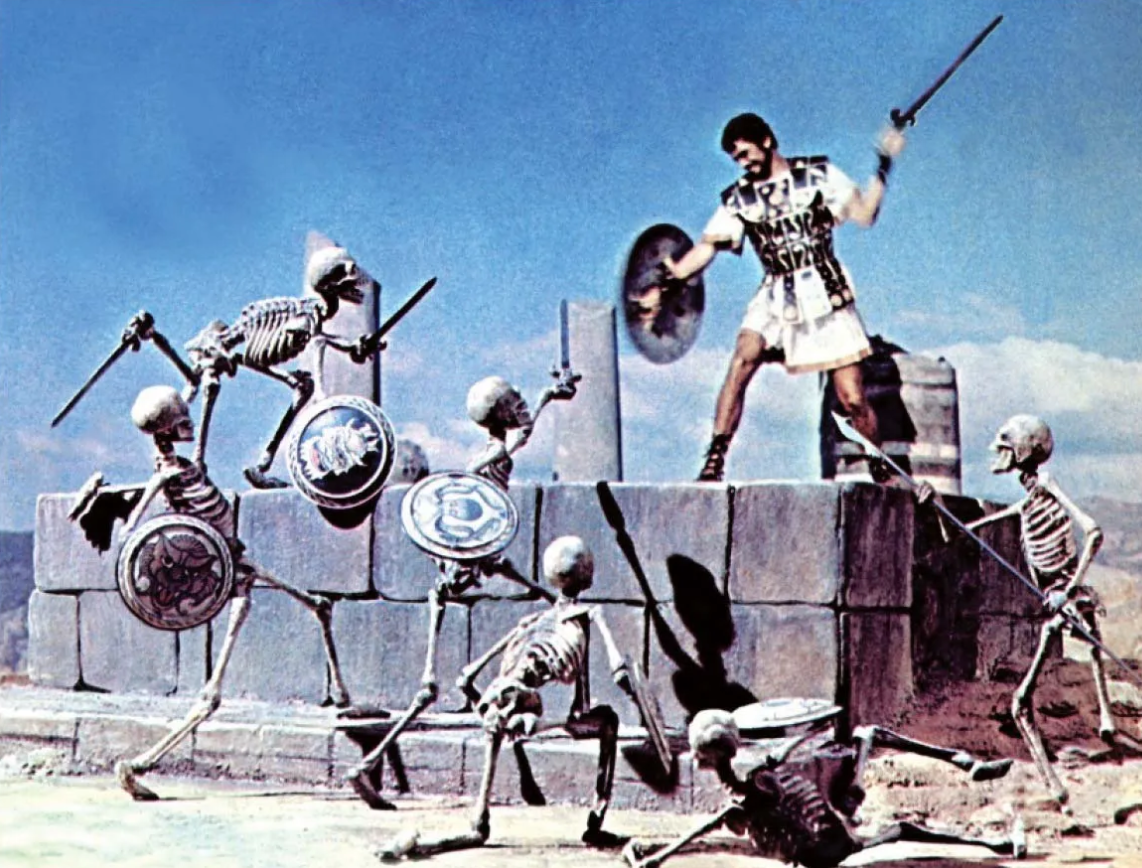
A third oddness is his assertion (p.192) that the target audience for my beloved Jason and the Argonauts is the same as for An American Werewolf in London.  I must beg to differ.

Anyway, back to the monsters. In Carroll’s definition, a monster must be threatening and also must violate our understanding of the basic categories we use to understand the order of the world.  This can happen in several ways.  Two mutually exclusive categories can be fused together, for example, living + dead = “undead,” like vampires and zombies.  Or, two mutually exclusive categories can exist in the same person, but at different times, like wolf + human = werewolf.  Or the same person can exist in multiple places, like a doppelganger.  In each of these cases, he tells us, this category violation produces “impurity,” in the sense Mary Douglas refers to in her classic book, Purity and Danger, and (he says) impurity leads to disgust and revulsion.  Another type of violation has to do with scale – something already creepy could be magnified into a much larger form (like giant ants) or could be collected into a much larger mass (like a flood of ants).

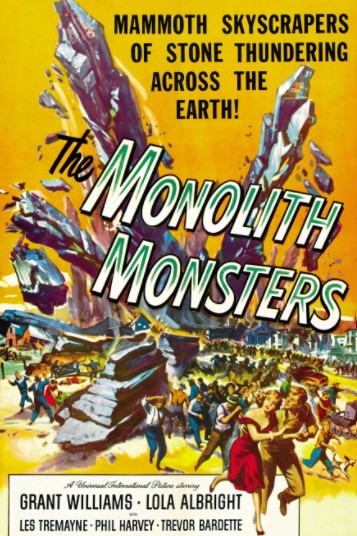
(Carroll’s definition doesn’t quite fit one of my old favorites, the 1957 flick The Monolith Monsters, in which fragments from a meteorite turn into gigantic monoliths that then shatter and start the process again, meanwhile draining all the silicon from everything they touch.  Threatening, yes, and certainly category-violating, but not exactly repulsive.)

(Also, his equation of “categorically impossible” with “disgusting” and “repulsive” is a misreading of Mary Douglas’s Purity and Danger.  Although some scholars have linked impurity and disgust, that’s not what Douglas was doing.  Rather, she tells us that such category violations are potentially powerful, psychologically, which can give them a major role in religion, and which can feel problematic (sometimes “matter out of place” = dirt).  Beyond what Douglas had to say on the topic, one glaringly obvious example is Jesus.  The idea that he could be both God and human caused considerable consternation to those among the early Christians who were philosophically minded – centuries of argument ensued – but none of them ever concluded that Jesus was in any way disgusting or repulsive.)

The “threatening and impure” themes in Carroll’s book then reminded me of the work I did in grad school with Gerard Saucier, where we studied the use of language to justify treating “out-group” members as worthy of mass slaughter.  In other words, it’s dehumanization to encourage genocide.   We studied numerous categories of mass violence, from ethnic cleansing and conflicts of religion or belief systems to settler colonialism and callous mistreatment of indigenous people. When the in-group felt the out-group was threatening (being the “wrong” ethnicity or religion or aligning with the wrong belief system), they were often targeted for elimination.  When the in-group felt the out-group was less than human, however, they could carelessly be used as tools or slaves (as in the rubber harvesting program in the Belgian Congo or the Mexican peonage system), or they could be forcibly relocated (as in the U.S. Trail of Tears), and if they didn’t survive, no big deal.  Those that were threatening and didn’t fit into the supposedly proper category (like being the “wrong” ethnicity for the country) could be treated as monsters, a frightening problem to be solved.  The list of metaphors for describing out-group members that I collected as part of the project illustrates this clearly: demons, cockroaches, murderous vultures, worms, savages, food for dogs, dangerous microbes, invasive germs, pigs, bloodsuckers, spiders, vampires, weeds, filth, maggots, abscesses, parasites, trash, swarms of insects.   Every one of those is a good candidate for horror, with the possible exception of weeds.  (Although if you’ve ever seen the blackberry vines in my part of town…)

In the United States, as we all know, we’re currently experiencing serious polarization, which on the one side has been deliberately cultivated by leaders and their favorite media, and which on the other side has reflected a great deal of shock and consternation that our neighbors could think like that.  Each side sees the other as problematic, and it can be very easy to dismiss the others and try not to have to deal with them.  We aren’t quite at the point of dehumanization, I hope, at least not for most of us, but the divides can be painful.

While I was reading Carroll’s The Philosophy of Horror, I was also still reading Steve Ellerhoff’s Jung and Star Wars, which I wrote about in my last post.  I came across a very useful quote on page 174. The context was very different (the life of Luke Skywalker), but I think it applies to our situation too.  Ellerhoff quotes Donald Kalsched: “[This] is our work – finding the humanity in the ‘enemy,’ even if the enemy has been possessed by evil.”  Our fellow Americans are, I hope, not “possessed by evil,” but many make the case that those on the opposite side of our political divide have been seriously deluded.  With this quote we can remind ourselves to keep recognizing their humanity, not reducing them to “threats” or “lesser” than ourselves.

And as the children show up on our doorsteps tonight, some of them playing at being monsters, let us remind ourselves that the original point of Halloween was the permeability of boundaries between sharp binaries – overcoming those rules tied to categories.  With Halloween, historically, the binary was life and death, but let’s extend that, if we can, to “us” and “them.”

Posted in narrative science, US politics | Tagged , | Leave a comment

The retconning of America

This past weekend, it was great fun to discover that the bookstore clerk-owner I know as “Steve at Tsunami” has written a new book!  It’s a fun book, too, a Jungian look at Star Wars, and on Saturday we attended the book’s launch party, which was also tremendously fun.  (Steve can sing!) 

In the first chapter of the book, he looks at how complicated the Star Wars universe became for its fans when Disney bought the property from George Lucas and relegated the years and years of related Star Wars media to the status of “Legends,” so that Disney could tell its own stories and have them become the official “canon.”  Now the movies were still “true” – including maybe that fun 1984 TV movie, An Ewok Adventure — but the many, many Star Wars novels were not, like Dave Wolverton’s The Courtship of Princess Leia, which I’d enjoyed, and the Timothy Zahn books that my husband still talks about.  The twins born to Han and Leia never happened, nor did fan-favorite Mara Jade, who married Luke.

I first saw Star Wars on 7-7-77 at the long-gone Mayflower Theater on East 13th, here in Eugene.  I remember that the floors were very sticky, probably from the many wildly enthusiastic kids spilling their sodas in excitement.  I then saw The Empire Strikes Back in Beaverton, and Return of the Jedi at some theater near the Oakland Airport.  What a fun story!  For me, those movies were the Star Wars canon – I didn’t need the others, although I’ve seen four of them (I, II, VII, and Rogue One).  However, George Lucas did authorize an entire Extended Universe of all of those novels published up until 2012, and many of my favorite authors were among the contributors. 

In his book, Steve talks about the fact that Star Wars is a living mythology, and he takes more of a “polyphonic” approach, noting that just as in ancient mythologies there were numerous stories of the gods and their doings that were not always necessarily compatible with each other, so too we can embrace all of these versions of Star Wars as valid.  (I wanted to say “true” instead of valid, which is an amusing way to think about fiction, isn’t it?)  For a new viewer, focusing on what happens to Rey can be even more vital and compelling than what happened in the older movies, so their understanding of the Star Wars universe will be much broader and deeper than mine.

I’m not that far in Steve’s book, so I don’t know if he’s going to address the problem I’m concerned with, which is the frustration fans feel when they encounter “retconning.”  Short for “retroactive continuity,” a retcon is when what happens in a newer book or film tells us that something in earlier books or films wasn’t correct.  A handy example for people who are my age or older is the moment in the TV series Dallas when J.R. Ewing wakes up and the viewers discover that the entire previous season was “all just a dream.”  That is, things Dallas viewers had learned about the story world were not actually true in that world, after all.

A great recent example is the anime series Blue Exorcist.  Anime is often based on graphic novels (manga), and sometimes the filming schedule gets ahead of the manga, so the anime writers will have to create filler.  In Blue Exorcist, the anime writers had to invent a story for episodes 17-25 for season one… but meanwhile the manga writers had their own ideas of how to resolve the problems raised in episodes 1-16.  Season two of the anime then followed the manga – the anime just ignored episodes 17-25 and jumped back in time to the end of episode 16 and went on from there, with no in-story explanation at all.  Very confusing!

Adaptations change the story all the time.  In The Fellowship of the Ring, readers know that Glorfindel takes on the job of delivering a badly injured Frodo to Rivendell, but in the Peter Jackson movie, it’s Arwen.  There is no “really happened” to compare notes with; we just have two versions of the story, with one being true in one context and one being true in another.  A retcon would be if J.R.R. Tolkien had then gone back and told us that Glorfindel had never existed.  Poor Glorfindel.

Fans generally don’t like retcons.  They’ve created the story world in their minds, based on what they’ve read or watched, and they have feelings about the characters and what happens to them.  They very well might like to expand on what’s official, writing their own fan fiction or enjoying authorized or unauthorized works by others, but they still want things to be backwards-compatible with what they already know.  Taking that away feels like a violation of something they value.

Here’s a real-world example.  As of 2006, Pluto is no longer a planet.  Our solar system has eight planets.  How do you feel about that?

And now it’s time for me to connect things up with political psychology.  On October 9, Trump issued a proclamation of the importance of Columbus Day.   It’s today!  In his proclamation, he described Columbus as “one of the most gallant and visionary men to ever walk the face of the earth” and said that “we pledge to reclaim his extraordinary legacy of faith, courage, perseverance, and virtue from the left-wing arsonists who have sought to destroy his name and dishonor his memory.”

Ironically, as Heather Cox Richardson explained in her blog post last night, the creation of Columbus Day was actually intended as a celebration of American diversity.  The Christian nationalist Ku Klux Klan had been persecuting Catholics, and FDR wanted to acknowledge the value of our many Catholic citizens, including Italian-Americans, so this new holiday was created.

Nowadays, the persecution of American Catholics no longer makes the news (although individual Catholics like Joe Biden may beg to differ).  And nowadays, many people have come to think more critically about the European conquest of the Americas, acknowledging that tens of millions of Native people died in the process and that it has taken centuries for those of Indigenous descent to be treated with respect by the European-American majority.  Instead of recognizing Columbus, many states (including my own) now celebrate Indigenous People’s Day.

This reappraisal of our history can feel very much like retconning feels to fiction fans.  My grandpa was proud of his ancestor William Bradford, who came over on the Mayflower (the ship, not the movie theater).  I was taught to feel proud that one of the original Pilgrims was part of my family tree.  (Bradford has something like ten million living descendants, so I’m not that special!)  However, since my grandpa’s time, we’ve been reconsidering Bradford’s legacy.

It’s my understanding that Bradford and his fellow Pilgrims did negotiate with the local people to be allowed to live on a specific patch of land, so I don’t feel too awkward about him.  However, a precedent had been set, and dozens and dozens of other people who came from England in the first half of the 1600s are also among my ancestors.  Surely they didn’t all ask the Wampanoeg and Narragansett and other locals for permission to claim other patches of land, nor did they stay put.

Those of us growing up in Oregon were also taught that our pioneers were special, helping to settle and civilize a vast continent that had been wilderness, or at least not optimally managed by the people who had already lived here, who had mostly “vanished” anyway.  Books like Roxanne Dunbar-Ortiz’s An Indigenous People’s History of the United States have helped set the record straight.  We now know that the United States largely stole the land we now live on.  Sometimes we made treaties that were ignored, and at other times we took the land we wanted and moved the Native people elsewhere.  If my grandpa were alive today, he might no longer be quite so proud of his own grandfather, who’d come out on the Oregon Trail and helped drive cattle between Oregon and California before settling, first in northernmost California and then up near Salem, Oregon.  Or if he had felt proud, now he might feel retconned.

There’s another important context in U.S. history where retconning has happened, and in this case it was deliberate.  In the South, the entire Lost Cause movement that romanticized the Confederate side in the Civil War – and even slavery itself – has been a deliberately orchestrated effort to help Southerners feel okay about how the South used to be and even to give them a sense of grievance for its loss.

One key difference between historical retconning and retconning in fictional worlds is that with history, the facts exist.  There can be different perspectives on what happened, but they can all be fact-checked.  Further, there’s an important arbiter of how we should craft our understanding of what happened historically, and it’s not the decision of who owns a fictional world’s intellectual property.  It’s ethics.  You and I are responsible for understanding what our ancestors did, and for listening to those who have most directly born its consequences. 

The thing is, when we learn more about the settlement of the United States, we get a much deeper and richer understanding of our world.  All of our ancestors were doing what they thought best, given the contexts in which they lived and their need to do well by their families, even though we now know that the net effect of their hard work also included costs to others.  We can value our ancestors and their decisions and the stories of their lives, and we can also value the Indigenous people and their decisions and the stories of their lives. 

In a way, it’s like fan fiction – giving us new layers to appreciate, more nuance, more perspectives. But it’s the real world – the Extended Universe of U.S. history looks not to Disney nor to George Lucas but to historically documented facts to tell us whether the stories we’re telling ourselves are valid.

Posted in history, US politics | Tagged , , , , , | 1 Comment

Individuals or groups – whose story should we tell?

Today I discovered that the New York Times has an interview with Elizabeth Warren on “America’s Next Story,” which got me excited.  I am quite fond of the senator and was curious to see what she would have to say on the current story of America – what we should be encouraging as our current group meta-narrative. Who are we?  Where are we headed?  What is our common purpose?

Would Warren have something to offer as a counter to Trump’s rhetorical campaign for reinvigorating America’s “greatness”?

Unfortunately, no.  Warren’s interview stressed her long-time understanding that the American economy is “rigged” – if a family has a medical crisis, a long-term job loss, or a death or divorce, the game is pretty much up for them.  No matter how hard people work, it’s difficult to afford basic childcare, let alone buying a house.  America isn’t taking care of its people as well as many other countries do.

These are worthy goals, but it’s a missed opportunity for Warren.   The story she’s telling is not a group meta-narrative at all, and I think there’s an important point to be made here.

Two Types of Meta-Narratives

Warren is sketching a story for individuals in relation to their country.  This is a powerful type of individual meta-narrative:  Individuals are the protagonists, and the United States should play an important role in their life stories. As she puts it, “we’ve got to make this country work better for working families, so that we have an economy where a family can work hard, play by the rules and build real financial security and the promise that their kids can do better than they did.”  There are important strategic reasons for proposing a story along these lines – for one thing, most Americans across party lines can agree it would be good, and many are coming to believe that the Trump administration is falling short of these goals.

But that’s different from a societal meta-narrative, the type I’ve dedicated this blog to talking about.  The kind of story I was expecting from Warren was a story with America as the protagonist.  What is America’s purpose, its role in the world?  How is America falling short now, and what should America be doing instead?

Warren’s story is about individual Americans and what their government should be doing for them.  That’s not the same as suggesting the next step in the story of America itself.

Part of a Group

The key difference is whether the people in the story are treated as category members or as essential elements in a group, the group that comprises our country.  There’s a vital difference between parts of our identities that are the categories we fit into, and the parts of our identities that tell us we’re part of something bigger than ourselves.  Being left-handed, or especially tidy, or able to play the piano are categories.  Being a Catholic, or a university student, or a lifelong resident of Montana makes you a part of a group.  Sometimes you can ignore the groupness and just go about your day; at other times it can be vitally important to you.

There’s this great word that’s hard to pronounce correctly that means groupness: “entitativity.”  Six syllables!  I confess I’ve written it as “entitivity” more than once, but no, it’s “entity” plus “-ativity.”

If you’re in a category that hasn’t yet started to think of itself as a group, it’s easy for the mainstream to pick on you.  Often category members are relatively isolated and easy targets for the power of the main group to treat them poorly.  Many social movements, like Black Lives Matter and its civil rights predecessors, along with earlier movements to promote women’s rights, gay rights, farm workers’ rights etc., have arisen when a few brave souls inspired members of a category to start seeing themselves as members of a group.

The 2016 Story

Warren’s strategy, addressing us as individuals who happen to fall into the category of “Americans,” is a lot like Hillary Clinton’s 2016 campaign.  Remember the leaked e-mails?  They told us that at one point the campaign was considering 85 different slogans… and every single one of them addresses the voter as an individual.  “Stronger together” – “You’ve earned a fair chance” – “She’s got your back” – “Making America work for you” – “A stronger America one family at a time” – “Progress for the rest of us” – “It’s about time… and it’s about you.”

Contrast that with making America “great again.”  With Trump’s slogan, the country is the hero.  Maybe it’s fallen on hard times, but with Trump, in theory, we could get it back on track.  It’s implied that if America is great, its people are happy and better off, but the point is that if you’re behind the MAGA campaign, you’re part of something bigger than your individual life.  You can have a noble purpose:  The restoration of the United States.

(I’m in Trump’s target category – very white, ancestors on this continent since 1620.  However, although I was raised Republican, I was also raised “cosmopolitan” rather than “tribal” and with plenty of social studies classes impressing the value of the Constitution and the Bill of Rights into my psyche. Both of those factors pretty well inoculated me against MAGA.  I will note, too, that when I was a child, Oregon was famous for its progressive Republicans who were national leaders in environmentalism (Tom McCall), women’s rights (Bob Packwood), civil rights (Wayne Morse, who later changed parties), and even pacifism (Mark Hatfield).)

The Power of Group Stories

Group meta-narratives are potentially very powerful, both in motivating people to identify with the group and in making sweeping social changes.  Because they’re so powerful, anyone promoting such stories (ways to think about the world and our place in it) must be very careful to ensure their stories are ethically sound.  Woodrow Wilson’s “Make the world safe for democracy” could be an ethical goal, depending on how we go about it.  Manifest Destiny, the meta-narrative entitling those of us with European ancestors to displace the Native people and claim the entire breadth of the continent for ourselves, was clearly not ethically sound.  “Give [us] your tired, your poor, your huddled masses yearning to breathe free” is a reasonable ethical message for a rich country that can afford to share its wealth and prospects with the rest of the world, although a case can certainly be made for due process.  Going to war against the Japan when its government chose to bomb Pearl Harbor may have been an ethical choice; treating our own citizens of Japanese ancestry as criminals was surely not.

With meta-narratives, it’s very much a question of ends and means.  An end may be worthwhile and highly motivating, but when the means involve harming innocents, the end cannot be justified.  Unfortunately, the process of creating groups out of categories makes it all too easy to set up an in-group versus an out-group, and the out-group becomes vulnerable.  The social movements of recent years have often had to focus on reminding the in-group that is America that we are all in it together – the very phrase “Black Lives Matter” is to remind us that Black people are part of the in-group, part of “us” and not an out-group at all.

What kind of group meta-narrative could the Democrat leaders offer?  Frankly, Trump is making it easy for them.  The United States created by the Founding Fathers was intended to be a land of justice, fairness, opportunity, due process of law, freedom of speech, freedom of assembly – a land where everyone has a say in the laws that govern us, and the confidence that those laws will be honored and apply to everyone fairly.  This vision, based on principles admired around the world, is what many of us were raised to understand as America’s true greatness.

It’s reasonable for political parties to have different beliefs about the relative importance of, say, national security versus individual opportunities, or whether the most vulnerable among us should be supported by all of us collectively or by private charities.  Personally, I’m looking forward to the day that we can return to taking our basic American values for granted and start focusing again on debating topics like these.

Now is when we need a Restoration meta-narrative, far more than in 2016.

Posted in narrative science, US politics | Tagged , , , , | Leave a comment

Psst, don’t tell the machines!

Because the very topic of this blog, for the most part, is the science of using language to try to manipulate people’s beliefs, my reaction to the idea of allowing artificial intelligences (AIs) to harvest my content was a big nope.  We definitely don’t need AI to improve its skills in influencing us.  Already, the Claude AI is plenty friendly – when you have a conversation with “him” it feels very much like you’re chatting with a real person. Some people may even be improving their mental health by chatting with closely monitored AIs – it can be easier to open up to a machine.

However, my husband pointed out that if I want people in the AI community to read what I wrote yesterday, I should rethink my position.  Many people working on AI use it as a tool to summarize what’s being said online, and if I’m not letting AI read my posts, these people won’t know what I’m saying.

I’m reminded of a conversation our research team had a while back, when we were analyzing the language used to promote genocide.  By laying it all out in one easy-to-read document, were we providing a recipe for future disaster?  But we weren’t revealing any hidden information, only the patterns within.  History’s genocidal leaders have already been learning from each other perfectly well.  When Hitler was talking about annihilating the Jews, he explicitly referenced the Turkish genocide against Armenians.  It’s all pretty much intuitive, anyway.  The point was that what we were doing could be used as the basis for tools to monitor the speech of problematic leaders and let people know what was going on before it went further. 

So, thinking about it more, I realized that, well, first, it would be trivial for anyone who wanted AI to know the content of my blog to input it manually.  The same goes for any papers or books I write – they’ll already exist in electronic format, so uploading them would be simple.

Second, why should I think I’m smarter than a near-term AI?  The techniques I’m writing about should be even easier for them to learn about than it was for me.  Reading through a vast body of the texts promoting mass violence and the literature of the environmental movement, and looking for common patterns, and connecting them up with psychological theories… that’s probably a matter of seconds for even today’s AI.

What I’m doing is bring it to humans’ attention.  I’m telling humans that, hey, meta-narratives and salience markers are things people use to influence each other, sometimes with dramatic consequences.  Humans need to know this.  And if I want to bring it to human attention, I should maximize my opportunities for networking, no?

So… I’ve turned “third-party sharing” on (or back on, if that had been the default).  If you agree with me that it’s important for humans to know at least as much as machines do about how language can influence humans, please – help by sharing my work with other humans.

Image source (cropped)

Posted in Uncategorized | Tagged | Leave a comment

Dramatic language, and other dangers

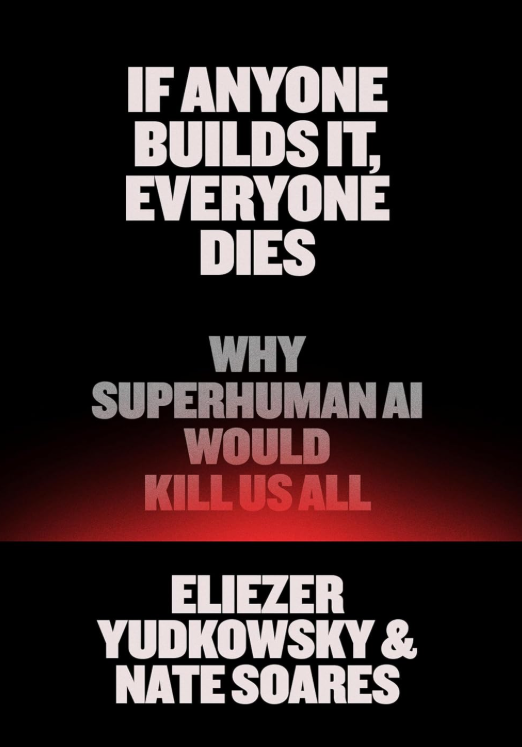
This past weekend, my husband participated in a Berkeley conference sponsored by the LessWrong community, an online group focused on rationality and decision-making.   Today he’s sporting a t-shirt he got there, which features the title of a forthcoming book by two leaders in the community, Eliezer Yudkowsky and Nate Soares.  

(And what a nifty way to publicize a book – send people out into the world wearing its provocative title!) 

The authors are highly concerned about the prospects for artificial intelligence.  Recently it’s become very convenient to use AI to answer quick questions – as long as one then follows up by checking the sources, as today’s AI is known to “hallucinate.”  In the future, however, we may be in for some serious problems.

The main issue is that it would be impossible for humans to fully supervise an artificial superintelligence (ASI).  It may set its own goals, and maybe even hide them from us – and there’s no way to guarantee that those goals would be compatible with our continued existence.  It may take over all the resources it needs to meet those goals, and any side effects for humans and the rest of the natural world would be irrelevant.  I like this paragraph from a booklet my husband brought home from the conference:

“Unless it has worthwhile goals, ASI will predictably put our planet to uses incompatible with our continued survival, in the same basic way that we fail to concern ourselves with the crabgrass at a construction site. This extreme outcome doesn’t require any malice, resentment, or misunderstanding on the part of the ASI; it only requires that ASI behave like a new intelligent species that is indifferent to human life, and that strongly surpasses our intelligence.”

Some leaders estimate the extinction risk for humanity at 10% in the coming decades; others think the risk is considerably higher.

Okay.

So I wanted to stop and think for a moment about the emotional impact of the book title.  It’s a meta-narrative – a story-like idea about a group (all of humanity) and its status over time (we could all die!).  It’s also a highly emotionally laden expression, fully charged with what I call “salience markers” to grab our attention, associate an idea with emotion, and potentially inspire us to act (vote, tell our neighbors, buy a book, attend a rally, change our entire lives).

My concern is that the title is so extreme that it could very well provoke the same type of denial we see with climate change. 

As we all know, climate change has been in the news for decades now, and although scientists and activists alike have stressed that we’re in it for the long haul whether we act quickly or procrastinate, many activists have used very strong statements to get attention, like “We have only 12 years to save the Earth,” otherwise “billions will die.”

The problem is, whenever we encounter something so strongly phrased, our first motivation is to defuse the threat. The simplest way to do so is to discredit it, not to fix the underlying problem. The stronger the statement, the greater the desire for denial.

Factual accuracy is not relevant in this context.

And when the problem is new and strange and something only a very few people know much about, it’s probably even easier to dismiss. 

This book title is using salience markers amped up to the max.  “All” and “everyone” are extremes, focusing on thoroughness.  There’s an us/them binary, pitting “us” against “anyone,” a threat that could come from anywhere, which also ties in to the family of salience markers that references hidden information. And of course “kill us” and “dies” are evoking that highly potent life/death binary.  They’re using language for maximum emotional impact.

That means the motivation to dismiss what they’re talking about as melodrama is also maximized.

One advantage that Yudkowsky and Soares have over the climate situation is that they’re experts themselves.  Although concern about climate change was originally bipartisan, many of us learned about it from Al Gore, and he had severely damaged the cause simply by being obviously partisan.  He’d been the Democratic vice president, after all, making him a “them” to Republicans who see U.S. politics as an us/them binary.  If Gore had made a point to always appear with a conservative who shared his concerns, like a high-ranking member of the military or a leader from our Christian communities, we’d probably be much further along in addressing the problem by now.  We don’t know as much about Yudkowsky and Soares so we’re much less likely to dismiss them as one of “them” – a group our very identity sets us against.

Another advantage is that superhuman AI requires investment – a lot of work would have to go into making it possible – whereas climate change is something that would happen if we don’t do anything.  In theory, we could solve the problem simply by stopping the work on AI development.  Or, at a minimum, we could figure out how to align the interests of future superhuman AI with the rest of the planet, including humanity.  It’s my understanding that many in today’s AI community are currently researching that very problem.

A third advantage is that AI is more like CFCs than climate change – if we can get the world’s leaders to agree, regulations could more or less solve the problem for us.  We should note, however, that the GOP’s “Big Beautiful Bill” would severely constrain our ability to supervise whatever it is the tech bros are brewing up.

Another complication is the partisan nature of messaging style.  Ever since Newt Gingrich, Republicans have understood the importance of using emotionally charged language to engage the public.  As George Lakoff has explained at length, however, the Democrats have long emphasized facts and figures and “rational” argument – the kind of discussions that are perfect for ironing out the details of policy but not for the earlier and at least equally important step of selling their ideas to the public.  As long as the Republican party is beholden to its high-tech backers, they’re unlikely to agree to regulate their behavior, and the Democrats aren’t even listening to language like “kill us all” because it’s the very opposite of cut-and-dry.

If the authors of this new book want to sway public opinion, it’s vital that they get their message right.  Perhaps they’ve already weighed the risks of appearing overly dramatic – or perhaps their publisher insisted on a title like that, and they decided the gamble was worth it.

In the environmental literature, though, books like The Population Bomb have had problematic histories – sparking a wave of activism and action, but also a backlash where people end up focusing on many of the book’s more extreme speculations and dismissing the entire issue out of hand because “it never came to pass” (as if the book itself didn’t play a role in averting the crisis).  I hope they don’t have the same thing happen to them. 

One of my colleagues (Branden Johnson) is embarking on a study about public views of global catastrophic risks and extinction events.  I’ll be interested to hear what he learns and whether the public is yet aware of superhuman AI.

Meanwhile, we should probably all be educating ourselves, right?

Sources:

“Unless it has worthwhile goals”; extinction risk: Machine Intelligence Research Institute.  The Problem. 2025.

“12 years”: Wagner, Gernot and Constantine Samaras. “Do We Really Have Only 12 Years to Avoid Climate Disaster?”  New York Times, 19 September 2019.  At https://www.nytimes.com/2019/09/19/opinion/climate-change-12-years.html

“billions will die”: Lovell, Jeremy.  “Gaia scientist Lovelock predicts planetary wipeout.”  Reuters, 20 January 2007. 

Posted in salience markers | Tagged , , | 1 Comment

Maslow’s Pyramid versus the Deep/Nanny State

Earlier this week, I was thinking about the “ACK!” that most of us have been feeling, in regard to Elon Musk’s rampage through the federal agencies. This ACK is closely related to the “why does some billionaire get to have all of our personal identifying information?” ACK and the “are those rallies really safe, or just an excuse for martial law?” ACK. The “uhh so does our president really want to put our own soldiers in harm’s way while giving two million Palestinians cause to be furious with us?” is more a “WHUT.” than an “ACK!.”

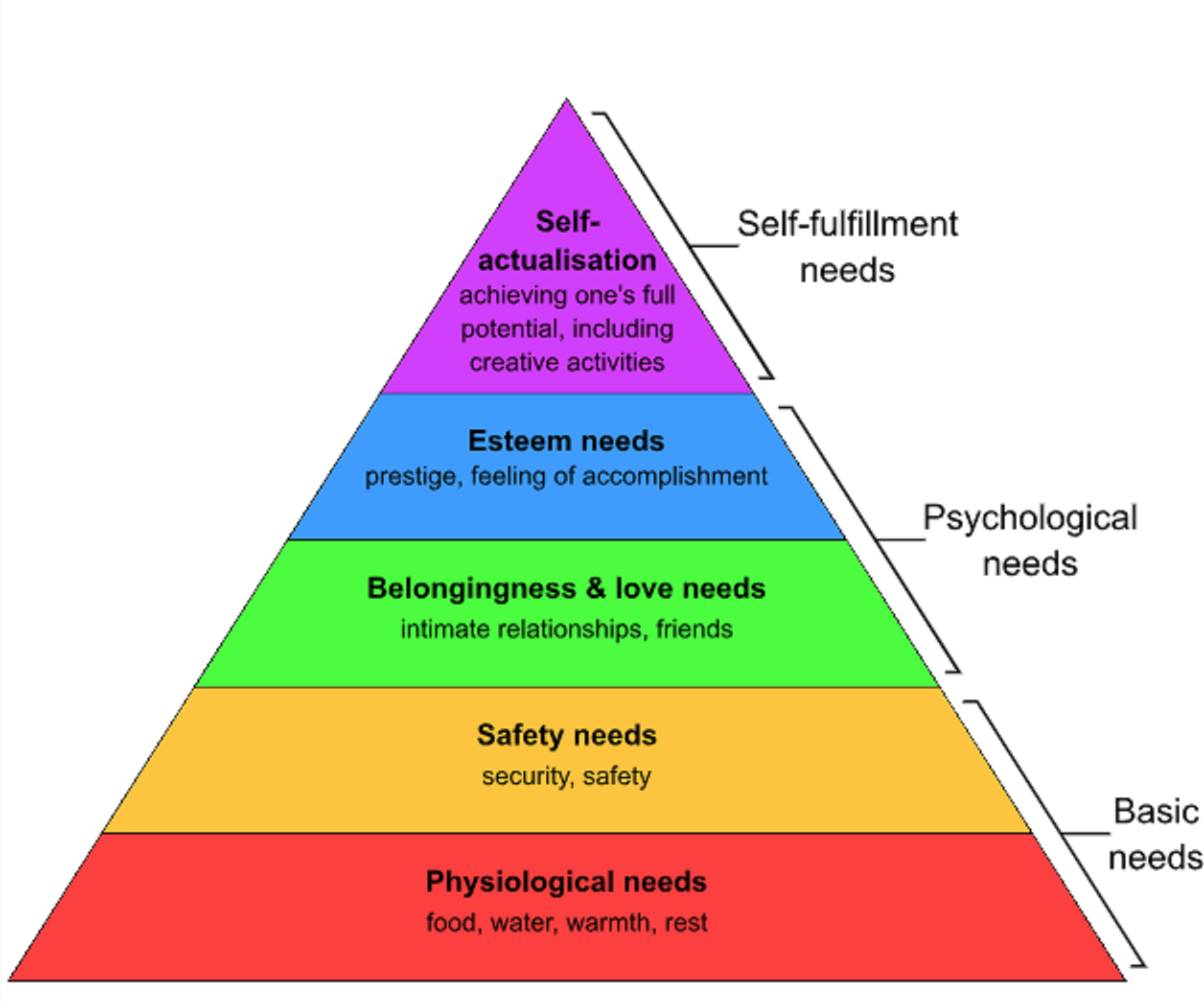
Why ACK? It comes down to Maslow’s Pyramid. Abraham Maslow realized that we need at least five categories of things to live and thrive. The most basic needs are things any living creature needs: food, water, whatever shelter or clothing the environment calls for, rest, etc. These are at the bottom of the pyramid, the base we need to build on for the rest. The further up the pyramid you go, the more we get away from the basics into things that can make life feel meaningful – connectedness to others, feelings of status and accomplishment, creative self-expression. Our need for safety and security appears near the bottom too, right above our basic physical needs, because it’s also fundamental to being able to do everything else.

One important aspect of security is feeling like the world works how we expect it to work – being able to have faith in our institutions. I will note that although we all need this, it is fundamentally a conservative need. Traditionally, conservatives become annoyed by programs to change how things work, for whatever good cause, because there’s a value to having things stay put.

But obviously we all need to be able to expect that our jobs, our retirement plans, our health care systems – pretty much ALL of our systems – will keep on happening and be there for us to rely on. This is a fundamental human need. Sometimes these things change, and when that has to happen, we want our society to go through some thoughtful and deliberate process so that we can all agree on the types of changes we want, and when possible, the pace that we want for making these changes.

So we now have our liberals and progressives going ACK! as Elon Musk starts dismantling these systems, while our supposed conservatives look the other way. Weird.

Two things seem to be going on. First, our Left is on average more educated than our Right. The Left may be far more aware than the Right that we actually need what these agencies do. We need our safe food, safe drugs, safe cars and trucks, clean water, clean air, safe air travel, safe roads, prompt tax refund checks, prompt social security checks, certainly better postal service than they’ve been giving us the past few years, and so on.

It’s ironic, too, because the Blue states have been underwriting these services for the Red States for quite some time now. Blue states pay more per person in taxes; Red states take more per person in services. On the other hand, as George Lakoff points out, conservative families traditionally teach values like deference and self-discipline, so they end up framing the use of services as weakness and failure, whereas liberal families traditionally teach values like empathy, so they end up framing the providing of services as kindness and community-building. Very broadly, we can say that Blue state people want to help the Red states because we’re all in it together, while Red state people don’t want to feel patronized; they’d rather be self-reliant.

And that brings us to the other big thing that’s going on. The federal government, and its agencies, employ some 2.3 million people to do all of these useful things. For many of us, these are just regular people, people like us, doing regular jobs. However, some on the Right have been conducting campaigns to influence the public into seeing these agencies not as “regular people going to work to carry out the activities that our Congress has decided it wants done” but as something Bad. This Bad thing can be vague and sinister, a “Deep State,” or something way too involved in our personal lives, a “Nanny State.” One way it’s threatening, the other way it’s infantilizing.

(Given all the work I’ve done on the type of language used to justify mass violence like genocide, I’ll have to note that these are the two ways most often used to characterize out-groups when we don’t want our people to see them as basically just like themselves. Either they’re potentially harmful, like demons or vermin, or they’re too helpless to take care of themselves, like Andrew Jackson referring to the Cherokees as “our red children.”)

So if the federal government and all of its vast array of programs is reduced to a single idea, it’s either threatening (“Deep State”) or too pushy for real adults and thus unwanted (“Nanny State”). Nobody points out that it’s only billionaires who can do for themselves what the federal government does for the rest of us. I certainly don’t have staff to grow all of my food for me in some vast unpolluted landscape over which I have complete control, let alone the ability to hire scientists to research and find cures for whatever illnesses I may eventually contract, and engineers to make sure all of the products I buy are safe. Billionaires can try for that, not me.

What’s the point of reducing the complexities of the government to a simple negative idea? It means our feelings about the government are likewise simple and negative. In other words, as my colleague Paul Slovic has described it, it creates an “affect heuristic” – an emotion-based shortcut that tells us what to do. If the government is a Deep State, we should oppose it, either by fighting it or by escaping from it. If the government is a Nanny State, we should fire it and reclaim our pride in ourselves. Those are the feelings and images that Trump, Musk, and MAGA are pushing at us.

But they’re wrong. That’s just propaganda, invented by people who don’t want to have to play by the rules that make things work for the rest of us. In reality, the federal government is our National Commons – it provides the structure and services we need to be able to do business with each other safely and easily across state lines. Highways and air travel, anyone? It’s also our Safety Net, giving us that vital layer of Maslow’s Pyramid that will catch us if we fall.

And unless we have the misfortune of dying young, we’ll all “fall” eventually. We need our Social Security, our Medicare, our cancer research, our veterans’ services, our consumer protection. And on a meta-level, we to be able to count on everything we’ve been taught to count on, so that we can have the peace of mind to take risks, like starting a small business or moving for a new job. If we are all hunkering down and waiting until the dust settles, then America can’t compete with the rest of the world.

With any luck, Elon Musk will lose interest in destroying our institutions once he’s finished with the ones that have been *ahem* investigating him and his iffy business practices. And with any luck, our Red state neighbors will remember soon that they actually need our National Commons and our Safety Net too, at least as much as the rest of us do.

Source for the Maslow’s Pyramid graphic: Wikipedia (By Androidmarsexpress – Own work, CC BY-SA 4.0, https://commons.wikimedia.org/w/index.php?curid=93026655)

Posted in US politics | Tagged , , | Leave a comment

My day with Brian Eno

Many years ago, when my first husband and I were getting to know each other, he made me four long “mix tapes,” cassettes of the music he wanted me to know about. My very favorite of all the works he shared with me was “St. Elmo’s Fire,” by Brian Eno. Here it is:

So guess what I did on Friday? I experienced “24 Hours of Eno”! There’s a new film that’s a documentary biography of Brian Eno, which has been available in theaters but on a very limited basis. When it was here in town it was for one night only, which sold out quickly, and an evening in a fully packed movie theater is no longer my idea of fun, so I signed up for learning when it would be available live-streamed. Friday was the day, billed as “24 Hours of Eno.”

The event included five showings of the movie Eno, along with a prerecorded conversation between the producer/director Gary Hustwit and Brian Eno, and a prerecorded panel discussion between Hustwit and four other members of the film crew. (There was also a fair amount of ambient music as filler, which gave me time to step back and think about what I was seeing, take a walk, and you know, eat dinner and all that.)

The point to the multiple showings, and much of the excitement about the event, was that this film is the first serious example of what they’re calling generative film-making. Each viewing is a different version! I read somewhere that there are more than 200,000 possible versions. In practice, the beginning and ending scenes are the same, as well as some common section anchors. During the panel discussion Gary Hustwit said that the versions are about 30% the same overall, and about 70% different. Version 4.120 started too early in the day for me; I watched versions 4.121, 4.122, 4.123, and the beginning of 4.124.

(In practice, at least for adjacently numbered versions like that, I was experiencing much more than 30% overlap. It felt like 4.122 only had maybe 40-50% new material compared with 4.121, and then for 4.123 (which strongly resembled 4.121), it felt like only 10% was new, so with 4.124 I was definitely getting diminishing returns, and as this version started at 3 a.m., I concluded I would be happier instead getting ready for bed.)

Anyway, back to the subject of the films. Like many British musicians of the 1960s and 1970s, Brian Eno (who is now 76) had been an art school student who discovered that there was very little going on in the world of painting, but that music had become a fertile ground for creativity, so that’s where they went. Eno, in particular, appears to think of himself much more as an artist than a musician. His musical career began as a member of the band Roxy Music, after which he had three conventionally structured solo albums (and by “conventionally structured,” I mean he was creating songs and organizing them together for publication as an album). My favorite of his songs was on one of these albums, Another Green World, and all three albums are simply wonderful.

After that, his career shifted. He began creating what he calls “ambient music,” music to be playing in the background while another activity is going on, perhaps to create a space for deeper focusing on that primary activity, and sometimes (as in the case of Ambient 1: Music for Airports) to put the listener into a more transcendent frame of mind without necessarily being aware of it. Meanwhile, he started working with other recording artists as a producer – U2, David Bowie, Talking Heads, Devo, and others. David Bowie described his contributions as “philosophical” – it seems that Eno’s focus was more on expanding the artists’ thinking about what they were doing and using wordplay and other techniques to help them make new connections and increase their creativity.

From watching the film, I can say that Brian Eno is an extraordinarily thoughtful person. He thinks – a lot. He’s kept diaries of much of it, stacks and stacks of them. He is very much aware of his creative process, and it looks like he has a lot of fun waking up and starting every day as an artist. He was saying so many thought-provoking things, too, that I was greatly enjoying my “24 Hours” of immersion in his way(s) of life and the insights he was sharing.

One point that kept coming across was the idea of all of human self-expression as art – that is, in contrast to the narrow understanding of art as something we go find in a museum or concert hall, this is the broader understanding of art as something everyone does, much or all of the time. But while it seems quite possible that Brian Eno is so thoughtful that at this point his ethical life is foundational to everything he does – he’s clearly concerned about politics and the planet – this overall ethical orientation is not something the rest of us necessarily share.

When he was talking about self-expression as art, for example, I started thinking about all of those January 6 protesters who had received presidential pardons this week. For some of them – like that guy known as the QAnon Shaman – their “visit” to the Capitol Building could definitely qualify as artistic self-expression. And that’s not to say that because it’s art it’s not also criminal. Some of the most notorious criminals treated their crime sprees as art projects.

This all got me thinking, then, about the ethics of art. I’d love to read more about it.

A simple example is consent. When we go to a theater to see a movie we’ve already heard all about, or to a concert hall to hear a performance of specific works, we are obviously giving informed consent to experiencing works of art. That’s at one end of a spectrum. If we’re just going about our day, and some loud and obnoxious art-thing suddenly appears in our faces, that’s obviously a lower level of consent, and if the art actually harms us, as in a work of terrorism, that’s at the far negative end of the consent spectrum. But we can’t always consent, because we share public space. If I decide to walk around downtown wearing a bizarre combination of colors with a plastic flower arrangement on top of my head, I’d be inflicting my self-expression fairly harmlessly on the other people downtown, but they wouldn’t really be justified in telling me to stop.

Much of the point of art is to get us to question our assumptions, so art will often be transgressive – breaking boundaries, showing us other possibilities.

On the other hand, much of the point of art is for us to lose our individuality, temporarily, in a greater whole – the Eno film includes the example of singing as a group, but most other group activities also qualify. We get caught up in belonging to the group and surrender our “selves” to the greater whole. Here the importance of ethics is obvious, because we cannot necessarily trust that the group dynamics will lead to outcomes we would choose if we could step back and think about them clearly.

In the film, art is almost always for good. It’s creative, intriguing, thought-provoking. There’s a moment, though, where they show Pete Townsend of The Who smashing his guitar on stage. In a voiceover, Eno mentions someone they’d learned about in art school, whose work suggested the desirability of destruction as an artistic act. Looking it up, I think it was Gustav Metzger. Clearly I’ll want to read more about that. What are the limits? Is it like irony, which is far more effective as a criticism than when it’s central to a program? Historically, when leaders start breaking their country’s systems, people suffer. A lot. I’m thinking of Chairman Mao’s program to “Smash the Four Olds” (China’s old ideas, old culture, old customs, and old habits), but other examples may come readily to mind for you. (!!!)

(This example showed me a potential down-side of generative film-making – the ways it complicates scholarly citation. When I want to say, “Eno said…” I can cite which version of the film I was seeing, if I happen to know it, but I can’t go back and verify it, and unless the full script is published somewhere, no one else beside the filmmakers can verify it either.)

In conclusion, I can strongly recommend the idea of immersing yourself for 24 hours in a work of art that gives you new ways of thinking about things, especially if you can do it in the company of a brilliant artist like Brian Eno. But as a cautionary note, I’d like to reiterate that much of the value of the experience is in the reflection – thinking through the implications and how it fits with your own values – rather than total immersion, where you’re giving up your own perspective to adopt someone else’s. A work like Eno supports the former, and in a world where we’re being encouraged to fall in line politically as part of our new leader’s personal art project, we need all the help we can get in clarifying where we ourselves stand.

Image source: https://floodmagazine.com/184622/24-hours-of-brian-eno-livestream-announce/

Posted in Uncategorized | Tagged , , , | Leave a comment

Trump as Trickster

Today I read Carl Jung’s essay “On the psychology of the Trickster-figure,” which was published in his book, The Archetypes and the Collective Unconscious. My goal was to see what good it might do us to have Donald Trump as president, beyond the value he’s already given to the millions of voters who used their ballots to express their frustration with the Biden administration.

A trickster, as you probably already know, is someone who flagrantly violates all sorts of rules and expectations, because it’s in their nature or because they can get away with it or because it’s fun. As Jung puts it, “Although he is not really evil, he does the most atrocious things from sheer unconsciousness and unrelatedness.”

In gaming alignment terms, this person is “chaotic neutral,” with an emphasis on “chaotic.” He doesn’t care about consequences (“sheer unconsciousness”) and doesn’t have much empathy (“unrelatedness”). Usually this person is mythological or fictional, like Loki or Coyote or Bugs Bunny. You and I, however, get to see one on TV pretty much every day, if we look for him.

From wacky ideas like adding Canada and Greenland to the United States to his anti-constitutional approach toward making cabinet appointments to his alarming attacks on our basic institutions, Trump is very much a Trickster.

When Trump spent that Pennsylvania rally dancing to his campaign soundtrack, many commentators saw it as evidence of his cognitive decline. That was one possibility, but it could also have been just, whatever, he felt like dancing, so he did. If the rules don’t apply to you, why not revel in it?

(Honestly, I’d rather have a leader who spends his campaign rallies goofing off than let him test his theory that he could get away with shooting someone in downtown New York City.)

For his most devoted followers, Trump’s outrageousness is a big plus. In today’s slang, “it’s not a bug, it’s a feature.” They want him to be the powerful outsider who overthrows the system and saves them from its tyranny. And this was something I learned from Jung today – the Trickster is often expected to take on the role of “savior.” He’s not bound by the rules, so (in theory) he can cut right to the heart of problems and fix them.

However, the presidency of the world’s most powerful democracy is an odd place to find a Trickster. As Fareed Zakaria says in The Age of Revolutions, “… democracy is about rules, not outcomes.” It’s jarring, if not outright worrisome, to put the care of our most precious institution into the hands of someone who doesn’t value it – indeed, who consistently violates its basic premise, that rules matter.

And yet, Donald Trump has twice been elected President.

Part of it probably comes down to education. The more we everyday citizens know about the federal government in all its complicated nuances, the more we understand how much we actually rely on its services. I’m thinking back to the people who were vigorously anti-Obamacare but insistent on keeping their ACA coverage – not realizing that the two are identical.

For many Trump voters, though, the federal government isn’t the people who make sure we get our health insurance, our tax refunds, our disability benefits, our national parks, our safe drugs and clean air and clean water and clean food supply. Instead, it’s some vague and apparently menacing “Deep State.” Our distress at the disruption of the government is vivid and meaningful, whereas for many of them, it’s “shaking things up,” which could be worth it.

As Arthur Koestler wrote, “Habits are the indispensable core of stability and ordered behavior,” and “the defeat of habit by originality” is “an act of liberation.” For Trump fans, the same may apply to social conventions and even laws.

Another aspect of the Trickster is that even though rules don’t apply to them, that doesn’t mean the rules are gone – it just means the Trickster is the exception. When Biden pardons his son, that’s bad. When Trump pardons the members of his family who have done things arguably worse than Hunter Biden, that’s just Trump.

And now we’re seeing others who want in on this flouting of rules, like the tech bros signing up as Trump fans. If you’re facing legal challenges, like Elon Musk, maybe the easiest way to disregard regulations is to disband or defund the agency in charge of seeing they get carried out? Trump was openly courting the angry young dudes who apparently see themselves as entitled billionaire wannabes. Hey, let’s all be bigger than the law!

On the other hand, as Jung tells us, part of the social value of having a Trickster in our midst is that “it is the best and most successful method of keeping the shadow figure conscious and subjecting it to conscious criticism.” Every time we notice Trump violating something we value, and we talk about it, our values are reinforced. If we cannot take for granted our sense of underlying order, then its eventual restoration will feel all the more hard-won.

Usually, however, the Trickster figure is someone on the margins, not the one at the center of things. Even if the majority of voters get fed up with him – assuming their news sources let them know what he’s doing – the complicating factor is that Trump has been normalizing obnoxiousness.

To the extent that Trump is a role model for American citizens, it may take a lot of work to bring back graciousness, decency, and kindness – traits that even their most severe critics would still associate with presidents like Reagan and the Bushes.

The next four years are surely going to be “interesting.”

Posted in US politics | Tagged , | Leave a comment