
When I was a young adult, I lived for 11 years in Oakland, California. City life was a shock to my system – I was born on the Oregon coast, in a town that then had about 2,000 people. When I was 12 we moved to the “city” – first Springfield (which had about 35,000 people), then a few months later we moved three or four miles west to Eugene (about 100,000 people). Oakland is part of the San Francisco metropolitan area, though, which had about 3.25 million! And that didn’t even include San Jose!
San Francisco seemed to be almost entirely concrete, but thanks to a helpful coworker, I quickly learned that Oakland has plenty of forests. I started to spend time every day in Joaquin Miller Park and Redwood Regional Park, which were every bit as green as our Oregon forests. This is in Oakland!
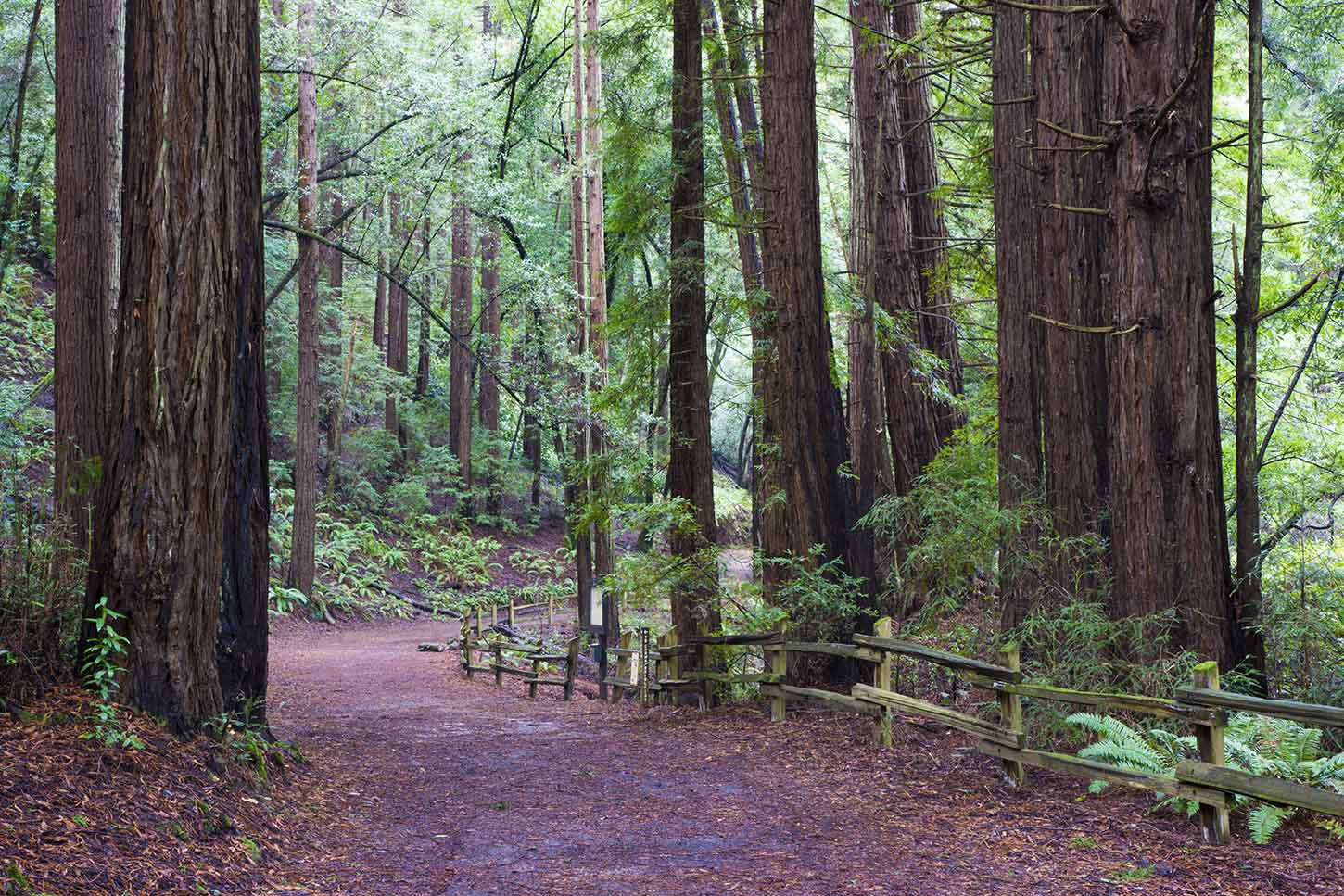
I also started spending a lot of time thinking about what forests and trees mean to humanity. I collected oodles of material for a writing project that never came to fruition, and when I went to U.C. Berkeley to finish my bachelor’s degree, I initially majored in Conservation and Resource Studies, learning more about the environmental movement.
I quickly came to an important realization, which fascinated me for quite some time. Over the years, the environmental movement had modeled itself on another social movement that had, centuries back, also taken civilization by storm: Christianity.
John Muir, one of America’s earliest environmental writers, regularly used religious imagery to convey how special the mountain wilderness was to him. Creatures and flowers were described as worshippers or preachers. Nature experiences: baptisms, conversions, redemptions, deliverance. Special locations were Eden or paradise. He compared them with the urban world, which was “haunts of the devil.”
Many key themes from Christianity have appeared in the environmental movement. The development of city life and industrialism has been described as are akin to the fall from Eden, and many feel a sense of shame or collective guilt for the harm humans have done to the Earth. We consider many human actions to be morally wrong – ranging from failing to recycle to strip-mining a mountainside. We know we should lead a simple lifestyle, as many Christian denominations have taught, and spending time in the non-human world can lead us to feel awe and wonder, just like religious experiences. Many have a sense of looming catastrophe, a human-caused Apocalypse, very much like the religious Apocalypse anticipated in the Book of Revelations – and many of us care about salvation, “saving” the Earth or the whales or a particular redwood tree. We have also begun to think about the rights of animals and even forests and rivers.
Together, these elements make up a storyline that looks very familiar to the Christian narrative: a fall from Eden and both original and ongoing sin; the potential to experience awe and wonder through contact with the sacred; the value of purity and the blank slate that comes with baptism or ritual ablutions; the specter of apocalypse; asceticism; conversion; and especially the importance of extending our ethics beyond those most like ourselves, as found in the parable of the Good Samaritan. My colleague Scott Slovic has even identified an environmental novel, David James Duncan’s The River Why, that was modeled closely on St Augustine’s Confessions – the main character gradually realizes that celebrating nature’s abundance is far more rewarding than treating it as a context for achievement and consumption.
I didn’t know about meta-narratives or cognitive framing when I was first thinking about this topic, so I wasn’t really sure what to make of this similarity except for the obvious conclusion – these ideas had worked (to some extent) for Christianity, so maybe they would work in the environmental context too.
Another obvious conclusion, which wasn’t how I thought about it, was Michael Crichton’s claim that environmentalism was a religion. I didn’t agree with him, but I didn’t entirely disagree either. Being environmentally active is an important way to find meaning in life, which is one of the things that religion can also do for people. Labeling it that way has obvious costs, though – it’s a way of claiming that environmentalists have their values wrong, and it also makes it harder for those who are religious to identify with the environmental movement, as if they’re somehow being disloyal to their faith.
As I discussed in an earlier post, a 2018 book by Nicole Seymour tackled the problem of identifying environmentalism with religion. She explained that decades of dramatic writing, both the awe/wonder side of things and the ongoing sense of crisis, have been alienating those who don’t already see themselves as environmentalists. However, as she describes, others have begun to create media that’s more playful, irreverent, or ironic – making many of the same points while inviting others in, rather than screening them out.
The reason this topic came to mind this week was that my partner showed me a post he’d found online by Natalie Jackson, expressing concerns that the Democratic Socialist Party is presenting itself like a religion. She notes the DSA’s “religious fervor,” its messaging focusing on “spreading the message that will save the world,” with “only one correct path.”
Comparing that list with what I said above about environmentalism, the DSA has a long way to go to catch up even with environmentalism, when it comes to religion.
I fully agree with Jackson that having “one correct path” isn’t healthy for politics. But when I look at the DSA page, helpfully linked to by Jackson in her post, I just see a standard party platform, just like Democrats and Republicans have, describing their goals in an idealistic way.
Many of the DSA positions seem great – wouldn’t it be nice if the United States could catch up to the rest of the world on access to health care? But I would argue with some of their ideas – I think there’s a value to having a Senate, for example, because it means more negotiating and more thoughtfulness.
I also think that calling themselves “socialist” is a poor idea. We can’t rely on voters to use “System 2” deliberation to overrule their “System 1” intuition, and the majority of Americans think socialism is BAD.
Whatever we collectively decide, as we rebuild our country from the colossal mistakes and mountains of debt our federal government *ahem* is currently inflicting on us, it’s going to take dedicated people and a lot of constructive thinking. I give the DSA credit for giving people good reasons to be enthusiastic about politics, when cynicism has become so very tempting.
Photo source: https://www.redwoodhikes.com/EastBay/RedwoodRP.html


