When Principles meet Loyalty, who wins?

I was probably right there on the Berkeley campus when the package arrived. I’d finally resumed work on my bachelor’s degree, and I also had a university office job, so I spent much of my time there. Thankfully, the package didn’t come into my hands, so I wasn’t on the receiving end of the Unabomber’s eighth attack. A grad student named John Hauser was – the enclosed bomb blew up his arm, and he only survived because a previous Unabomber victim was nearby and used his necktie as a tourniquet.

The Unabomber’s campaign of terror lasted another ten years, killing three people and injuring 23 others. Eventually, he mailed out a massive “manifesto” explaining his worldview, insisting on its publication. After much discussion with the FBI, a major newspaper agreed to publish it, in the hope that someone would recognize his writing style.

And someone did.

David Kaczynski had a trove of letters his brother had written over the years, and going back through them, he discovered phrases very much like those in the manifesto. With his wife’s encouragement, he reported his suspicions to the FBI. Ted Kaczynski was captured, convicted, and sentenced to life in prison.

I’ve always been intrigued by the story of David Kaczynski. What was it like to make that phone call? To turn in his own brother? But he had to act, or more people would surely die.

And I’ve always been intrigued, too, by the fact that we find his story so remarkable. Why was it surprising? Because we expect personal loyalty to outrank – to “trump” – principles. Or rather, sure, Continue reading

Posted in Uncategorized | Tagged | 2 Comments

From clickbait to transcendent meaning

This evening the weather was perfect for reading outside, and that’s what we were doing, enjoying the rustling leaves overhead, the trickle of water from our little fountain, and the antics of four of our cats, when my phone gave a beep. It was a message, in Messenger, from one of my neighbors. The message said, “Look who died, in an accident I think you know him…? so sorry,” with a couple of emojis and a link.

Naturally, I was terribly curious. I didn’t click the link, though. The message looked very like the sort of clickbait my mother-in-law had recently gotten from a friend’s hacked account, and I expect my neighbor is better with punctuation. Also, upon reflection, I also realized that this neighbor and I haven’t had that many conversations, so she doesn’t “think” I know various people. Rather, for any given person, she either knows for sure or doesn’t have a clue. Sure enough, a few minutes later she sent another message – don’t click the link, because she’d been hacked.

My big project for the past year or so has been studying the ways that people can make messages and ideas more dramatic and impactful. These techniques are familiar to anyone who’s encountered clickbait, but they’re also used in social movements, ranging from those encouraging us to broaden our ethical sensibilities (like caring more about nature) to those pushing us to contract them (as in mass violence, where leaders might want us to make war against people we’ve known and liked for years).

I’ve come up with five families of techniques that are commonly used to make information more exciting and interesting. They’re generally the same things that make art more visually interesting and music more emotionally moving, but they’re used here as ideas rather than part of the physical world. I’m sure I’ll write more about them here after I’ve found a good way to publish my work, but for now, I’ll just note that two of these techniques seem to me to be especially powerful.

The first is the contrast between existence and non-existence, that is, referring to birth or, especially, death. Research has found that making people think about death can make them more anxious and distressed (naturally!). Beyond that, though, sharp contrasts attract our attention, and as contrasts go, this is one of the sharpest.

The second is the realization or discovery of something you care about that was previously hidden from Continue reading

Posted in history, salience markers | Tagged , , , , , | Leave a comment

Fantasy worlds as thought experiments

Reading a fantasy or science fiction novel gives your imagination a good workout. Not only are you constantly watching for clues to help you paint a coherent picture of the story world and how it works, you’re sharing the viewpoint of a character (or several) whose problems are probably very different from your own. As with reading any fiction, you gain empathy for others – you are literally practicing perspective-taking. With fiction set in other worlds, however, you also learn to see your own world differently, experiencing this world’s problems without the biases that would intrude from mapping your own identity into the story (as one may do with historical fiction), and potentially gaining real-world insights. Also, spending the time mentally inside another world gives you a refreshing break from your own, especially if this other world is somewhere wonderfully strange.

Of course, if the world you’re having to learn is too strange, spending time there becomes more work than fun, and you might give up. Authors have to make tradeoffs between originality and familiarity. Fortunately, there are – well, not tricks exactly, but techniques – that authors can use to help. They can model their world on ours, hence the endless stream of fantasy novels featuring European-style castles, knights, et cetera. They can give their characters problems that, although challenging, are also very simple – all it takes to save Middle Earth is the destruction of Sauron’s ring. Or they can give us a point-of-view character who’s naïve and has to learn how things work too, alongside the reader.

My partner and I both love the Murderbot books, Martha Wells’s series about a human-shaped, artificial intelligence “Security Unit” that illegally hacks its governor module to get control over its body, manages its intense anxiety by binging on soap operas, and finds itself (to its horror) making friends. To be honest, Wells doesn’t use any of those “help the reader” techniques in this series, so it takes some work to follow the story at first, but the books are short and immensely fun. Since I liked them so much, someone – I’m pretty sure it was local author Nina Kiriki Hoffman – suggested I also try another series by Martha Wells, The Books of the Raksura. I did and I loved them. I’ve read the five main Raksura books twice now, and this week I was delighted when my partner decided to try them too.

The Raksura books, which begin with The Cloud Roads, are a series inspired by its author’s background in anthropology. There are probably dozens of intelligent species sharing a world in which magic is real but rather limited, and which is most definitely not Earth. Our point-of-view character, Moon, is so naïve that he doesn’t even know what his shapeshifting species is called, but, as any reader might guess, he soon learns that he’s Raksura. A Raksura can just look ordinary and fit in well with other ordinary folk, but they (at least some of them) can also transform into a winged predator that apparently looks something like a gorgeous, glorious cross between a dragon and the Creature from the Black Lagoon.

Cover art from The Cloud Roads:

raksura

Not long after he started reading The Cloud Roads, my partner started telling about parallels he was noticing between the world where the Raksura live and Lois McMaster Bujold’s Sharing Knife series. I hadn’t noticed them at all. The Sharing Knife books are set in an alternate version of North America – we start the story among farmers living in a fantasy version of Ohio (though it’s not called that), spend time both with Anglo-types and Native-types, and eventually travel the entire length of the Mississippi River (though again, it’s not called that).

But he had a point, and that brings me to my own point. I hadn’t really considered before that, just like Continue reading

Posted in narrative science | Tagged , , , | Leave a comment

Growing up “meta”

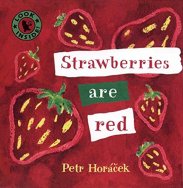
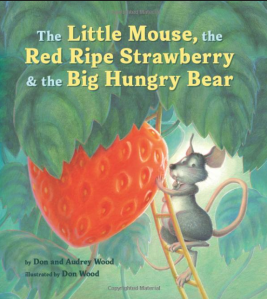
Our young friend Maddie recently celebrated her first birthday. Maddie loves berries and books! We do too! And thus, my partner and I gave her three books about berries.

One is a book about colors of fruit.berry_colors

One is a counting book. Did you know that technically, grapes are berries?

berry_counting

berry_storyAnd the other is a story. A cute little mouse finds a great big strawberry, but the narrator warns the mouse that a bear who lives in the woods would also like the strawberry. Bears are big and scary! As the narrator goes on and on, the mouse becomes more and more concerned. On one page, we see that the mouse has bound the berry in chains, holding the key to its padlock. On another page, both the mouse and berry are wearing Groucho disguises. Finally, the narrator makes a suggestion. The best way to solve the problem is for the mouse to cut the berry in half and share it. With the bear, I assumed? But no, that’s not suggested at all. With the narrator! And this is done, and having eaten half a humongous berry, the mouse is quite content.

My partner read me the story when the book first arrived, and I took it at face value. Today, though, before delivering the book to Maddie, I read it for myself. This time, I realized that, uh oh, the narrator was probably manipulating the mouse’s emotions to get some of the berry for themself. And while there’s an important role in literature for the “unreliable narrator,” who isn’t disclosing all their own knowledge and motivation to the reader, it hardly seems suitable to put the person reading aloud to the child in that role. Parent as trickster? Hm.

I grew up in what I now think of as a golden age for irony and meta-awareness in children’s media. My younger sister watched Mister Rogers’ Neighborhood and Sesame Street back to back, and the contrast between them was striking. It wasn’t just the pace, although that’s obviously different too, but the tone. Continue reading

Posted in Uncategorized | Tagged , , | Leave a comment

Real-life hopepunk

I’ve been meaning to write about hopepunk. One of my online friends, Susan Kaye Quinn, is a novelist in this newly recognized genre, and today she posted “A Brief History of Hopepunk.” Another online friend, the novelist P.J. Manney, has been hosting a Facebook group devoted to what she calls “The New Mythos,” recognizing the importance of giving people realistic hope for the future by showing them how people can work together ethically, even in very trying circumstances. That’s the essence of hopepunk. It’s what Aja Romano – in a terrific summary – refers to as “weaponizing kindness and optimism.”

Usually when I talk about the genres we can choose for our group-defining stories (meta-narratives), I’m talking about the directions in which we’re collectively headed. Are things getting better, like with progress? Are they getting worse – is there a potential catastrophe that we’d better avoid? But that’s not the only way we can categorize our meta-narratives. Another way is to think about what we, as individuals, can do as part of a larger group. That’s where hopepunk and its alternatives come in.

In 2017, the novelist Alexandra Rowland coined the term with this tweet: “The opposite of grimdark is hopepunk. Pass it on.” She later elaborated on her idea here, initially, and then in greater detail here.

Grimdark, as a literary genre, is all about cynicism and despair. There’s really no point in trying to do anything, because it will just get torn down. It’s grit, and it’s realism, and ugh. For most of the people living in the world of Game of Thrones, this is their reality. It’s common in cyberpunk, too – think Blade Runner.

But that’s not our only choice. You can also stand up to darkness and destruction, against all odds, not really expecting a final, conclusive victory, but fighting for what you know is good and right. Like the people of Ukraine. That’s hopepunk.

Putin, we are told, is in the grip of a Restoration meta-narrative, unleashing destruction to restore the borders of Imperial Russia. If the tsars controlled it, he wants it. Zelensky, by contrast, says the story of today’s Ukraine is the story of sustaining the land to which today’s Ukrainians have a personal Continue reading

Posted in narrative science, US politics | Tagged , | 2 Comments

In love with the land – the real clash of civilizations

What does it mean to love the land? Two very different things, apparently.

Today I was reading Ezra Klein’s column in the New York Times, where he was talking about anti-liberalism. Remember, we have multiple meanings for “liberal,” and this one means, to quote Klein, “the shared assumptions of the West: a belief in human dignity, universal rights, individual flourishing and the consent of the governed.” In general, both the Democrats and Republicans believe in this kind of “liberalism.”

By contrast, anti-liberalism is what we find on the wayyyy far right, with the kinds of thinkers who inspire fascists and who generally reject, for example, Christianity, since after all, it’s about human dignity and all that supposedly weak-minded stuff. What do they believe in, then? As Klein puts it, among other things, anti-liberalism says that “our truest identities are rooted in the land in which we’re born.”

I immediately thought back to a book my friend Doug was telling me about yesterday, Down to Earth, by the French philosopher Bruno Latour. Based on the publisher’s summary, it’s about the importance of rethinking what it means to “belong to a territory,” because being connected with the land is vitally important to being able to address ecological crises effectively.

So, on the one hand, we have identification with land being associated with scary far-right extremists. On the other, we have identification with land being important for the environment. What does this mean?

This actually came up for me a few months ago, listening to a talk by Robin Wall Kimmerer. She’s one Continue reading

Posted in environmental thought, Uncategorized | Tagged , , , , | 2 Comments

Mindset and “genius” – life lessons from the Schumanns

One of the most popular – and practically useful – concepts to emerge in psychology in recent decades has been Carol Dweck’s concept of “fixed” versus “growth” mindsets. Dweck, a Stanford researcher, found that in any given context, people tend to think of their abilities either as already determined and forming part of their sense of who they are, or as changeable, where their success will depend largely on their own efforts to develop their abilities. She calls these “fixed” or “growth” mentalities, and they also show up in her work as “entity” versus “incremental” ways of thinking. This is basically what people are talking about when they distinguish between talent and skill – one comes naturally and the other takes disciplined work.

In practical terms, this means if someone thinks being smart is an either/or thing (“fixed” mindset), then doing poorly on a test can be devastating. On the other hand, if being smart is a process (“growth” mindset), then doing poorly on a test is useful or even valuable, because it highlights where you should turn your attention next. The same ideas also come up in criminal justice – if you think a person is bad by nature, then prison will just be a place to keep them out of trouble, but if you think people can change, then prison should include educational opportunities and rehabilitation.

(I’m not claiming Dweck was totally original with this. It reminds me of Alfred North Whitehead’s philosophy, in which processes are more real than substances. It’s also closely linked, I think, to the Buddhist teaching that suffering comes from our unwillingness to accept that nothing can ever last. We want some things to be fixed and certain, for our basic sense of security and predictability, but there are limits on how far we can actually go with that, given how biology works. Dweck’s contribution, I’d say, is that she gives us a practical, fairly easy way to shift our thinking that can improve our daily lives.)

Today I learned a fascinating new thing – this mindset distinction actually plays an important role in Western cultural history: the idea of the “creative genius.”

My friend Barbara Harris recently started an online book club as part of her work with the Oregon Bach Festival. It’s free, anyone can join, and it’s fun. Our first book, The Little Bach Book by David Gordon, was mostly about what it was like to live and work in Leipzig in the early 1700s. Johann Sebastian Bach was not an admired superstar during his lifetime – rather, he was a hard-working, salaried musician Continue reading

Posted in Uncategorized | Tagged , , , | 3 Comments

Putin, Ukraine, and the “glory” trap

As Russia, under the determined leadership of Vladimir Putin, shocks the world with its invasion of Ukraine, Americans find ourselves wondering: Why????

Here’s what the New York Times says about Putin’s position.

“Mr. Putin has described the Soviet disintegration as a catastrophe that robbed Russia of its rightful place among the world’s great powers and put it at the mercy of a predatory West.”

and, “Mr. Putin has also insisted that Ukraine and Belarus are fundamentally parts of Russia, culturally and historically,” that is, that “Ukrainians are ‘one people’ with Russians, living in a failing state controlled by Western forces determined to divide and conquer the post-Soviet world.”

After the breakup of the Soviet Union, Ukraine had been closely allied with Russia, just as Belarus is, but in 2014 they shifted toward the West and had been aspiring to eventually join NATO and perhaps the European Union.

So, in essence, the problem comes down to two motivations, which Putin has apparently decided are worth a huge investment in Russian lives and Russian economic well-being.

The first motivation is a strong desire to shift where Russians are on what we might call a fear-trust axis. Fear and trust are mutually exclusive, and Ukraine has had generations of reasons to mistrust Continue reading

Posted in history | Tagged , , , | 10 Comments

All the “porns”

mediterranean_dietThe last time I was in our neighborhood supermarket, I narrowly avoided buying the latest special issue of Good Housekeeping, full of recipes for the Mediterranean diet. Although I was tempted, $13.99 was non-trivial, and I reminded myself that if I want to eat something new, I could always unpack more of my mom’s cookbook collection.

Later I realized that my interest in the magazine had been visual – everything looked so delicious! Even things I would never actually want to eat, like cooked tuna. If that was the magazine’s real appeal, many of my mom’s cookbooks would work equally well, including those already on my shelves. I don’t actually need fresh “food porn.”

This metaphoric use of the word “porn” has been around for more than 40 years. Wikipedia says it originally drew on the “excitement” and “unattainable” themes in conventional pornography, but now it just means food that’s been beautifully photographed. (Along with whatever gratification your imagination can supply… like real porn, I suppose).

I’m also a big fan of “landscape porn.” My Windows screensaver is a collection of photos I’ve found online, and whenever my laptop’s sat idle for 10 minutes, I find myself enjoying a world tour of beauty. Most of my favorites show water and forest together, like this picture of the coast of British Columbia:

skidegate_narrows

Or this one of Lake Tahoe:

tahoe_emerald_bay

But some are forests full of wildflowers, like these bluebells:

belgium-forest-bluebells-forest-nature-or-is-it-hertfordshire

*happy sigh*

And then there’s my other favorite, “competence porn.” Although I’ve never watched it, my understanding is that MacGyver is the classic example. But my Perry Mason rewatch also qualifies. Everyone is always on top of their game: Perry, Della, Paul Drake. Even Lt. Tragg. Yesterday I was watching the episode where a glamorous novelist played by Beverly Garland (who later became the new mom on My Three Sons) had a secretary (a lovely young Louise Fletcher, more familiar to us from her subsequent roles of villainy on One Flew Over the Cuckoo’s Nest and Star Trek: Deep Space Nine). One or both of these women was being framed for murder, with a scarf left in a coffee can. Perry made the case that when he’d taken the scarf, he wasn’t removing evidence. As he told the judge, the police had examined the murder scene, and they knew how to do their jobs. If the scarf had been there then, they would have found it.

The Murderbot Diaries, a series of novellas by Martha Wells, also qualifies as competence porn. Our protagonist is a humanoid artificial intelligence with enough low-quality human tissue to provide it (its preferred pronoun) with emotion. This person (who ironically calls itself “Murderbot” but whom everyone else calls SecUnit, for “security unit”) is extremely socially anxious, constantly self-soothing by internally streaming its favorite episodes of soap operas (and I would love to get to see The Rise and Fall of Sanctuary Moon). But it is also extremely competent. The best.

The gratification one gets from competence porn isn’t the same as looking at a luscious bowl of berries, but it’s still there. It’s about confirming our faith in people (human or otherwise) – they CAN get things right.

(Also, competence porn doesn’t mean mistakes are never made. It means people learn and try harder to get things right – that’s competence too.)

So, food porn, landscape porn, and even competence porn are about relaxation, unwinding, engaging the imagination in ways that restore the spirit. Taking a few minutes out of daily life for a brief reset. That’s great!

But this all brings me to a strange and iffy new type of “porn.” Last week on Nova, they had an episode about Arctic sinkholes – the results of underground explosions of methane, a dangerous greenhouse gas. Continue reading

Posted in Uncategorized | Tagged , , , , , , , | 4 Comments

Every voice counts

I heard a fascinating talk today by Martha Bayless, who is one of our university’s folklore professors, and whose CV is full of awesome things, like medieval humor and games, food, and magic. She also curated the ongoing exhibit on medieval magic at one of our local museums.

Today’s talk was about an Anglo-Saxon queen named Eadburh, whose reputation was thoroughly trashed by the (all-male) chroniclers of her time. Her name was pronounced something like “ay-odd-burra,” and Wikipedia tells me she lived in the late 700s.

As it happens, there are no instances of Anglo-Saxon women being written about in a positive way, unless they’d given birth to some important man or devoted their life to the Church.

Eadburh’s story was more typical. First, she was said to have deliberately poisoned one of her husband’s closest friends and her husband, the king, accidentally died too – poison being the womanly way to murder people. Then she visited Charlemagne, who offered her the choice of himself or his son, and she picked the son because he was closer to her own age (with the implication that, horrors, she might be Continue reading

Posted in history, US politics | Tagged , | Leave a comment