
A few weeks ago, I was eagerly awaiting the final episode of Sanditon. It was a Masterpiece Theater series based on Jane Austen’s unfinished novel of the same name – she’d introduced the characters and the setting, but didn’t live long enough to tell the story, so it wasn’t obvious how it would end. Charlotte would surely end up with the man she wanted, but what about Miss Lambe, the young heiress Austen had described as “half mulatto”? Would she marry the duke to get the fortune seekers to leave her alone, or would the duke be free to pursue his intimate friendship with lovely Arthur Parker? And how about our more mature lovers, the rascally lawyer and the king’s ex-mistress? Or the much more mature lovers, Lady Denton and her long-lost, now rich, childhood sweetheart?
(Arthur Parker is the best!)
 That last week, it felt hard to wait for the ending – especially when the cable’s schedule said there would be a “shocking revelation” (and thankfully that was a total misrepresentation – there was nothing shocking nor a revelation, only a reasonable misunderstanding). Then I realized that with PBS Passport I could easily watch the final episode online, immediately.
I declined. I realized I liked having a whole week to wonder how things would be resolved. It’s a normal human thing to take pleasure in suspense, at least where recreation is involved. Otherwise we’d never sit down to watch or read a story at all.
And I’m accustomed to the pace of television that I grew up with, where you waited from week to week to learn what happens next, and sometimes spent the entire summer waiting for a cliffhanger to be resolved. This binging of an entire series over a few days is alien to me.
I’m not a purist – with anime shows I’m fine with watching two or three episodes back-to-back, and a few more the next night, and the next, especially if the entire show is hundreds of episodes long.
In real life, too, there are a great many ways in which it’s wonderful that we don’t have to wait and wait to find out what’s happened. I can’t imagine living in the 19th century, when if someone you loved moved away or went on a long trip or – ack – went off to war, you’d have to wait for them to write and send you a letter so you’d know they were okay. It was much better when I was a kid – if anything important happened, they could probably use the phone. Now it’s trivial to send a message instantly using that handy device we all carry in our pockets.
I wonder, though, whether this all points to a way our speeded up society has changed that we tend to overlook. If we don’t like dramatic tension when it’s only recreational – if we’d rather binge and get it all at once – then how can we bear such suspense when the stakes are much higher?
 My all-time favorite professional basketball player is Šarūnas Marčiulionis, who played for the Golden State Warriors. He’s Lithuanian who came to the U.S. from the Soviet Union, and I was continually shocked by some people’s hostility towards him as a “Russian.” Didn’t they understand that the Russians had forcibly conquered Lithuania and were thus even more of a threat to him and things he valued than they were to American interests? Well, no, they didn’t, and I kept thinking how painful it may have been for him to be called “Russian” by ignorant Americans.
 Recently I was rewatching one of my favorite BBC mini-series, Cranford, based on the novel of the same name (and several shorter works) by one of my favorite authors, Elizabeth Gaskell. Her books helped open people’s eyes to the human costs of Britain’s Industrial Revolution, and she’s also known for being good friends with Charlotte Brontë.

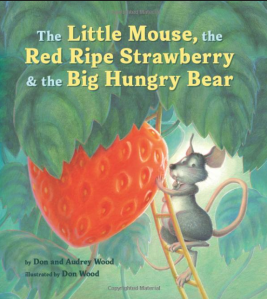 And the other is a story. A cute little mouse finds a great big strawberry, but the narrator warns the mouse that a bear who lives in the woods would also like the strawberry. Bears are big and scary! As the narrator goes on and on, the mouse becomes more and more concerned. On one page, we see that the mouse has bound the berry in chains, holding the key to its padlock. On another page, both the mouse and berry are wearing Groucho disguises. Finally, the narrator makes a suggestion. The best way to solve the problem is for the mouse to cut the berry in half and share it. With the bear, I assumed? But no, that’s not suggested at all. With the narrator! And this is done, and having eaten half a humongous berry, the mouse is quite content.
