
So… can we learn anything useful from video games about how to deal with climate change? I recently wrote a book chapter on this very topic! The book came out in August 2025 (or, officially, in 2026 – I don’t understand how that works), and I was just reminded of it when I got an email from one of our editors, telling me the book just got a review in an Oxford yearbook. Cool!
The book is called Imagining Ecocatastrophe: Reading Literary and Cultural Texts in the Global Context. It was edited by Scott Slovic, Joyjit Ghosh, and Samit Kumar Maiti and published by Routledge. As with many academic press books, the hardcover price is pretty fancy, but the paperback is $48.74. Or you could look for it in your friendly neighborhood university library.
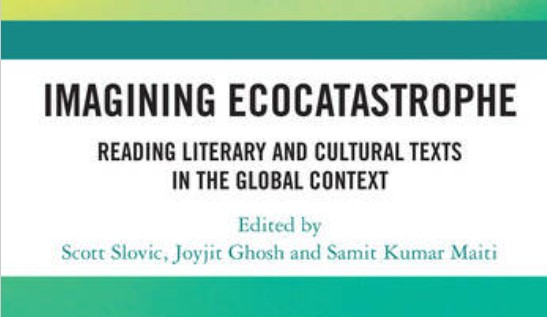
My chapter’s called “From One World to Another: Immersion in Digital Games and its Relevance for Climate Change.” The other chapters are about works of literature, film, and even cartoons addressing a range of ecological disasters.
For now, I’ll try to whet your appetite with some of the juicy details from my own chapter.
Here’s the thing. Games, especially computerized games, are excellent for teaching skills and facts. Remember the 1984 movie, The Last Starfighter, where an arcade game in a rural California trailer park has been teaching a teenager all the motor skills he needs for starship combat? It’s not entirely unreasonable.
Computer games are also great for teaching facts. My Duolingo streak is up to 762 days in a row, and although I’m only marginally learning Chinese and don’t expect I’d retain most of my new vocabulary very long if I quit, a few of those words and phrases are probably mine for good now.
It gets trickier when we’re asking videogames to teach us about systems. Sure, we can learn the details of the carbon cycle, if we reduce the system to a series of simple facts, and a videogame might be a good way to do that. If you get too many variables in there, though, especially variables about complicated things like human behavior, and especially variables you’re expected to infer from experience, then learning becomes much harder to automate.
And speaking of systems, I’ve written before about System 1 and System 2, our two ways of thinking. Unless we’re especially motivated to be thorough and careful, we’re likely to walk away from any situation with just the gist of things, using System 1 – our most automatic “thinking” process, which typically gives us a very simple conclusion highly informed by emotionally laden details.
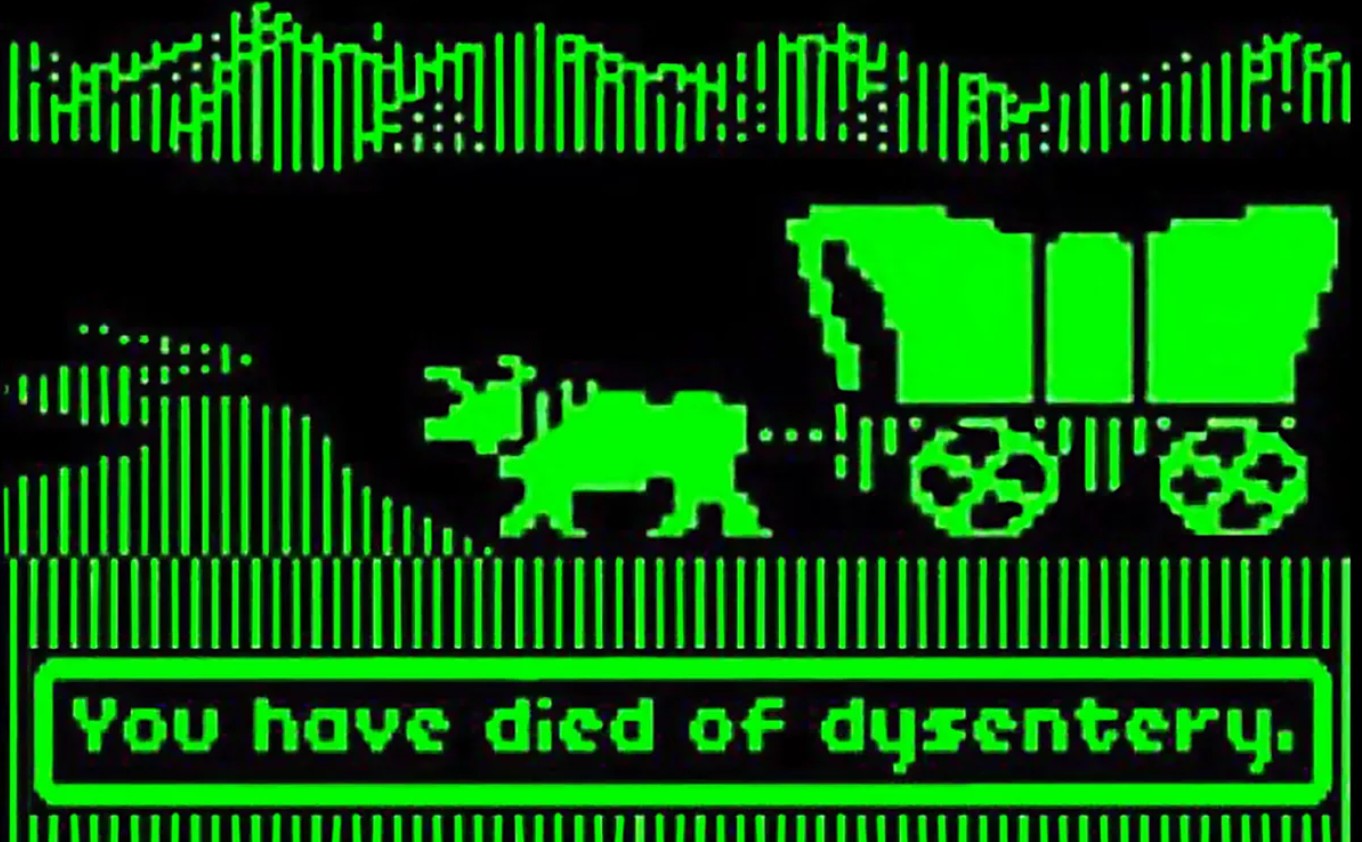
For example, one of the first popular educational computer games was called The Oregon Trail. Players took the role of pioneers setting out from Missouri for what they hoped would be a better life in the Pacific Northwest. The main thing most of us remember now about the game, though, is how often the characters would die from dysentery.
All eight of my mom’s great-grandparents made it all the way to Oregon or Idaho, and at least two of them did it the hard way, before trains were available. My mom’s great-grandfather James Kinyon was born in 1835 in upstate New York, near Vermont, and I was told that he drove cattle between Oregon and California. Later, an English-born teenage girl named Lydia Smith walked most of the way across the continent with her aunt and became his wife. Good thing for me they didn’t die from dysentery along the way!
Back to my book chapter. The key idea is something from Ian Bogost: the underlying models of games are making claims about how the world works. He calls it “procedural rhetoric” – we learn things from the experiences that are built into the game. If every person you meet in the game is threatening, then you come to expect that. If you can win the game by solving puzzles and challenges, the player learns that these are useful traits, and that – at least in this context – they have these skills. Reaching these conclusions is an effect of System 1 reasoning. It’s our overall impression of how the game works.
So when I was writing my chapter, I looked at some of the leading video games for teaching climate change to see what players might learn from them.
First, I tried a couple of games that show what can happen if you vary public policies related to climate change. Survive the Century and The Climate Game are both very short games – less than 20 minutes – where you try different things and see what happens. You can succeed with some scenarios, and in others you fail.
Unfortunately, the “procedural rhetoric” conclusion for both of these games is that tackling climate change is simple. You only need to spend a few minutes at it, and you’re done. And it’s easy to make mistakes – partly because you’re just guessing, unlike real-life politicians and journalists who have tons of helpful information and experts at hand.
At the other extreme, Fate of the World has you micromanaging numerous resources over the course of two centuries, again with far less information than real officials have. The takeaway messages are quite different from the other games. First, to quote one player, climate change is a problem of “soul-crushing difficulty.” Only bureaucrats can solve it, and the only solutions are technology fixes. Further, climate change can only be solved through violence! The easiest solution, for example, is genocide – wipe out China and India, and we’re probably okay. *ahem*
Then we have The Climate Trail, based on The Oregon Trail that I mentioned above. Playing The Oregon Trail can lead to empathy for our ancestors and the work they went through to get our families out here. The Climate Trail, however, tells us that unless we escape to Canada soon, we’re doomed – and Canada is probably doomed too. The net effect of this game is simply to reinforce our sense of climate anxiety.
In other words, from video games we can learn:
- Solving climate change is trivially simple.
- Or! Solving climate change is next to impossible.
- But… as private individuals, we’re helpless. Great.
- And, something we know is totally unrealistic: If we mess up, we get as many second chances as we need.
Thanks, video games!
In reality, dealing with climate change doesn’t happen from some central decision-maker governing the entire planet. And it’s already under way, although as with so many things, those who most need help are not the ones who are getting the earliest benefits. We can expect a variety of disruptions on our path to whatever our future will bring, but we can also remind ourselves that many smart and wise people are dedicating their lives to these problems. And we’re all here together.
And like so many things in life, this is a problem we have to learn to live with rather than a problem we can “solve.” Our desire to have it solved, and done with – which is System 1 thinking – is itself a symptom of how much stress we’re letting ourselves experience on the topic.
Coming soon, and also from that book chapter – ways that video games really can help us deal with climate change and other intimidating challenges that are often beyond our personal control.
Image source:
“Dysentery”: https://www.bbc.com/future/article/20241219-the-oregon-trail-how-a-50-year-old-video-game-defined-america


