The “Nixon-to-China” theory of change

For my friends who’d rather have had Bernie for president… don’t lose hope. Here’s why I think the Biden presidency may be just what we need.

In the early 1970s, mainland China was still recovering from the Cultural Revolution, a violent and disastrous experiment in totalitarianism, and the United States had been holding it at arm’s length, keeping China largely isolated from the rest of the world. Then Richard Nixon shocked America by announcing plans to visit China as a step toward normalizing relations between the two countries.

Now, where capital-c Communism was concerned, Nixon was an arch-conservative. He wasn’t all that conservative on women’s rights, environmentalism, etc., just as many Continue reading

Posted in US politics | Tagged , , | 1 Comment

Choosing your battleground: Joe Brewer’s story

Today is my friend and colleague Joe Brewer’s birthday. In honor of Joe’s special day – and tomorrow’s U.S. election – I’m sharing part of my in-progress book’s chapter 11, “Transcending Loss,” where I write about Joe and the importance of choosing not just your battles, but your battlegrounds.

My book is about the psychology of “meta-narratives,” the stories about the groups we identify with – our countries, our people, even all of humanity. Although optimistic meta-narratives are generally the most inspirational, sometimes decline and loss may be the most accurate representation of reality – and if we accept and grieve this loss, we can find ways to make a difference. Empires do fall; ecosystems can collapse. Our usual emotional responses to collective loss include denial, a sense of helplessness, and sometimes a paralysis born of communal guilt. How can we craft meta-narratives to help us function effectively when systems are failing all around us?

Joe-Portrait-for-WebIn 2007, Joe Brewer, a young man from rural Missouri, found himself reading George Lakoff’s books on cognitive framing, the conceptual models we use to make sense of the world (which include meta-narratives). With an academic background in atmospheric science, and deeply concerned about climate change, he began working with these frames to learn more about the thought patterns that can facilitate or hinder positive social change. Continue reading

Posted in Uncategorized | Tagged , , , , | Leave a comment

America’s Irony Problem

Irony can be a lot of fun.  And it’s everywhere, from the most scathing sarcasm to the gentle wit of Kermit the Frog. We love to laugh at satire and parody.  The “mockumentary” has become a popular film genre – a few weeks ago we greatly enjoyed the vampire satire, What We Do in the Shadows.  Yet there are some contexts in which irony may be altogether inappropriate and a serious problem for democracy.

Let’s start with definitions.  Irony requires us to have at least two levels of awareness.  There’s what we literally see and hear (or read).  Then there’s also a secondary level of meaning, more sophisticated, requiring familiarity with additional, unspoken knowledge.  That’s why irony is so popular with teens and young adults – appreciating it lets them show that they’re familiar with that deeper layer of knowledge.  Not only is irony fun, it’s also a metaphorical badge of mastery. Continue reading

Posted in US politics | Tagged , , | 2 Comments

The Axis of Awesomeness

Our collective stories about who we are and where we’re headed are potent elements of our culture, especially during election season, as you may have seen in my recent Scientific American essay and my earlier posts in this blog.  My usual way of classifying these stories is by their “emotional genres,” like Progress, Restoration, and Looming Catastrophe, which refer to the directions of the changes we’re experiencing and the way these changes make us feel.  I described a dozen or so of these genres a few weeks ago, and I used them in my SciAm article.

But here’s another way of classifying the stories about who-we-are-collectively, and that comes from what we think about our status.  Check out this recent blog post by Brian L. Steed. He’s part of the think-and-do tank Narrative Strategies, working with my friend Ajit Maan, an expert in how narratives affect our national security.

In his article, Steed classifies three prevailing American meta-narratives on what we might call an “axis of awesomeness.”  He describes three groups – those convinced that “America is Awesome,” those convinced that America has failed at awesomeness (“1619”), and those who see problems but also a potential for becoming more awesome than we currently are (“I Have a Dream”).  We can think of these groups as two with a “fixed state” mentality and one with a “process” mentality. 

Mentally, fixed states are easiest for us to handle, because once we’ve classified something, we know what there is to know about it and we’re done.  Processes are more complex because we keep having to pay attention, making sure the good things are happening that can support the desired changes and watching out for indicators that things may be going wrong.  It’s just like on the personal level:  Someone might think they’re the greatest thing ever, or they might think there’s some shameful reason that they’re essentially flawed – in either case, they can give up trying to do well (either because whatever they do is by definition fine, or because there’s no point).  Many of us would recognize that people are always works in progress, with good traits and less-good traits, and that what counts is our actions.  It’s the same for countries.

The United States clearly cares deeply about this “axis of awesomeness,” because it was founded on ideals, rather than originating naturally from people living in a certain land for centuries.  This “axis of awesomeness” is another way to think about American “exceptionalism” – that somehow, America is a special case, different from the rest of the world, and not to be held to the same standards because we’re beyond them.

When other people think about their countries, do they also have an “axis of awesomeness”?  Maybe, but for many, their “axis of vulnerability” may be more important, especially if they’re concerned about external threats.  In my post about the Spanish Armada, I talked about how England parlayed its “plucky island nation” story into parallel narratives of awesomeness and vulnerability, with both starting under Elizabeth I. 

One of the most challenging things about the current polarization of the United States is that it’s our very sense of awesomeness that’s become one of our biggest vulnerabilities.  People who are really invested in believing that America is and has always been the Very Best can feel that any criticism of the way we do things (and especially the way our ancestors did things) is taking something precious away from us. 

It can be hard to let go of our Triumph narrative and admit that, just like every other country on the face of this earth, America is a work in progress.  Nevertheless, we are.

Posted in Uncategorized | Tagged , | Leave a comment

The greatest honor

This week, when I saw that the Nobel Peace Prize had been won by the World Food Program, I confess my first reaction was, “Huh. That’s not as interesting as when an individual wins it,” and I scrolled on to the next news story.  My mistake!  Last night on Facebook, I found my step-brother Steve’s post:

“This award, in effect, is honoring my dad’s work posthumously, who ran the World Food Program in Nepal for seven years and preceding that assignment was second in command in India for three years. Although he died 16 years ago, had he lived to experience this global recognition he would have found it both a surprising and spectacular acknowledgment of the United Nation’s World Food Program’s humanitarian efforts – and of humanity itself – in what is otherwise an often inhumane world. Very proud of you dad!”

Arnold Childs, my step-father, was raised with public service as his highest ideal.  As a young man, he’d studied under the social philosopher Eugen Rosenstock-Huessy, at Continue reading

Posted in Uncategorized | Tagged | 2 Comments

The Science of America’s Dueling Political Narratives

I’m delighted to have my work appear in today’s Scientific American.  Please check it out!

Posted in Uncategorized | Tagged | Leave a comment

Our enduring debt to the 300 Spartans

Has it been 2,500 years already?

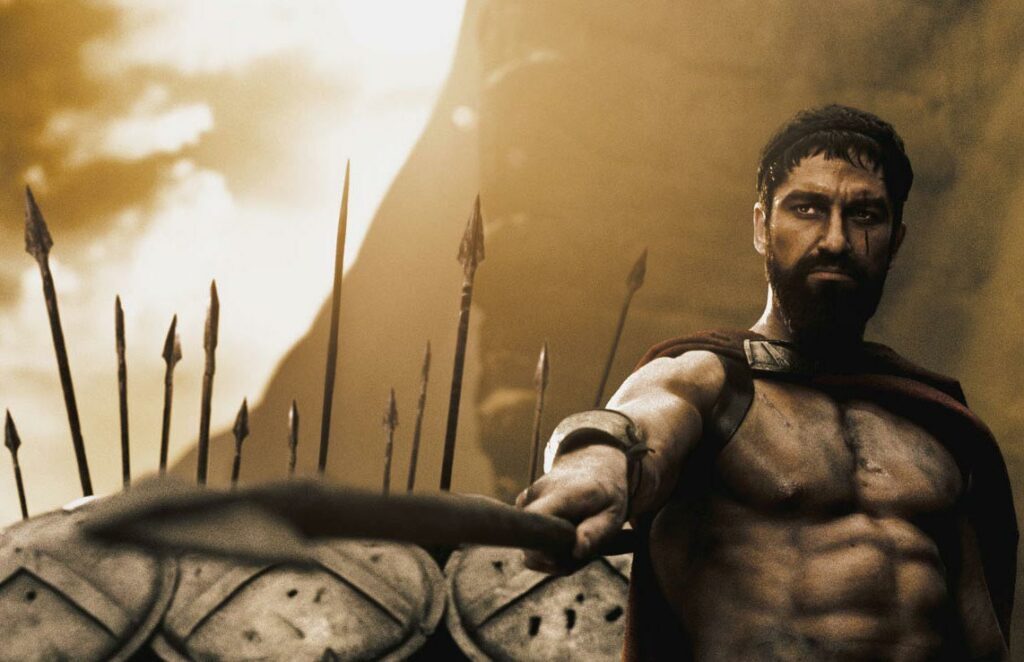
It was in August or September of 480 B.C. that King Leonidas of Sparta and his 300 elite soldiers (with some allies) held off more than 100,000 Persian soldiers for three days at Thermopylae, a narrow mountain pass into the Greek peninsula. Their valiant sacrifice (they eventually fell to a shower of arrows) bought the rest of the Greeks enough time to rally and, supposedly, save Western civilization from disaster before it had even fully gotten started. Hollywood immortalized their story in the 1962 film The 300 Spartans and more recently in 300, a blockbuster with almost half a billion dollars in box office receipts.

Why should we care about Leonidas’ stand at Thermopylae?

Is it standing up for freedom? Surely that’s part of the appeal – the Spartans resisted the attempts of Xerxes, the Persian King of Kings, to add Greece to his vast empire. Yet if that were the case, we would be equally dismayed at Alexander’s conquest of Persia and its holdings, about 150 years later, the same empire-expansion story in reverse. In both cases, those of us in the English-speaking world have been taught to take the Greek point of view. It’s “our” side, even though the majority of us have no Greek ancestors at all. Our affinity for Leonidas is more partisan than principled.

King-Leonidas-300-movie-01-1024x662Is it the awe-inspiring Spartans? For some of 300’s fans, especially, this could be true. Its cinematic style certainly glorified the Spartan world – where, ironically, freedom was not valued. Ancient Sparta could serve as a prototype for militaristic fascism. Newborns not meeting government standards were killed, and those who survived weren’t allowed to live with their parents, nor could young married couples live together. Plutarch tells us that once a year, some of the men who had inherited Spartan citizenship were allowed to freely murder any of the vast majority who had not. Adolf Hitler praised Sparta for its eugenics program and bloodline purity, and Spartan training methods inspired the curricula of elite Nazi schools. Sparta is shocking – but of course, that sells movie tickets.

Is it the “saving of Western civilization”? Most likely. In several important ways, classical Athens is a foundation of our modern world. We are indebted to them for the first great philosophers, the roots of Western science, and a political worldview that values input from individuals.

Today, many today are skeptical about the value of Western civilization. However lofty our ideals, we have a poor track record in practice. Europe and the countries established by European colonists have economically exploited virtually all of the rest of the world, and in some cases even destroyed other civilizations in the name of our own cultural superiority. The headlines of America’s newspapers – Black Lives Matter, climate change – still echo the mistakes of the Western world.

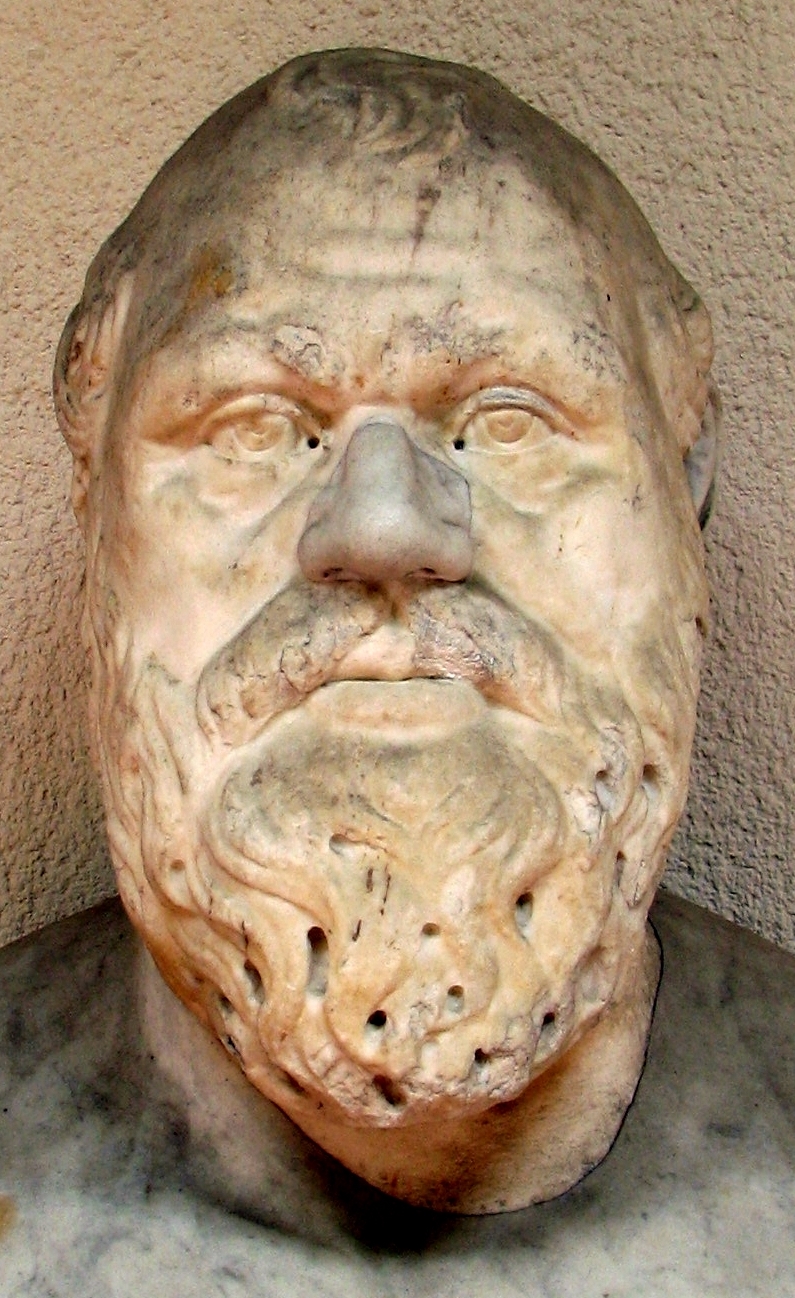
socratesI would say that the main value of Thermopylae comes from the life of a man born about ten years later. Socrates, the philosopher later called a “gadfly” by his pupil Plato, taught people to question assumptions, think carefully about the implications of our beliefs, and seek Justice and a higher Good. Late in life, Socrates was arrested and imprisoned (freedom of speech not being a feature of Athenian democracy). He was charged with the crimes of teaching the young people of Athens to think critically about its beliefs and values, that is, “corrupting the minds of the youth” and “failure to acknowledge the gods of the state.” He refused an opportunity to escape and accepted his execution by drinking poison hemlock.

Had the Spartans not held back the Persians at Thermopylae, the entire course of Socrates’ life would have been different. Even if he’d had the same temperament and teachings, he would have found himself protesting the injustices of Persian occupiers, not his very own people. His lessons would have been far less radical.

On the occasion of this extraordinary anniversary, we can reflect that the Spartan victory gave us something we can truly treasure – the example of a man whose life’s work was to interrogate the beliefs of his own people and the actions of his own government. That, I would say, is the real merit of Western civilization, the idea that each and every one of us has the responsibility to question authority and to carefully consider our beliefs and values – even, and especially, when they’re at odds with the examples our leaders set for us.

Posted in Uncategorized | Tagged , | 4 Comments

Oregon’s ex-fire marshal – too Good for the job?

Last week, when Oregon’s fire marshal abruptly quit his job in the middle of the biggest wildfire disaster in state history, many of us wondered what could have happened. Did he make some inappropriate political remark, maybe? Or gross incompetence? Apparently it was nothing of the sort.

Disclaimer: I’m not a journalist, and I know nothing about this story beyond what I read in yesterday’s local newspaper. The front page story says that on Thursday, an employee came to the fire marshal, Jim Walker, distraught because a relative was missing in Santiam Canyon, a zone where the fires had killed at least five people. Walker volunteered to help, and on Thursday evening he and a person who knew the area went looking for the missing relative and their family, eventually locating most of them. On Friday, Walker’s boss, the state police superintendent, said that Walker had overstepped his role and put him on leave. He then resigned.

Walker says he knew his employee was distracted by the situation, and that he’d cleared his search with someone he believed had the authority to do so. His motivation was to alleviate his employee’s concern, so that the employee could better “focus on the task at hand.”

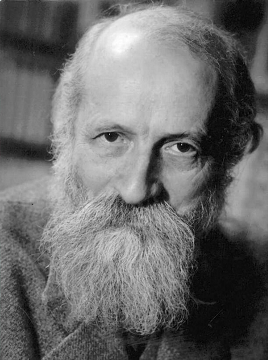
I was immediately reminded of one of my favorite philosophers, Martin Buber. He once told a story of a deeply unhappy student who dropped by to talk with him, and Buber was too distracted to give the man his full attention. Here’s how he described it:

“I had a visit from an unknown young man, without being there in spirit. I certainly did not fail to let the meeting be friendly, I did not treat him more remissly than all his contemporaries who were in the habit of seeking me out about this time of day as an oracle that is ready to listen to reason. I conversed attentively and openly with him – only I omitted to guess the questions which he did not put. Later, not long after, I learned from one of his friends – he himself was no longer alive – the essential content of these questions; I learned that he had not come to me casually, but borne by destiny, not for a chat but for a decision. He had come to me, he had come in this hour. What do we expect when we are in despair and yet go to a man? Surely a presence by means of which we are told that nevertheless there is meaning.”

buberThe student had gone off to war (the first World War) and apparently put himself deliberately into harm’s way (the wartime equivalent of suicide-by-cop). Buber was horrified – the young man had come to him for help, and he hadn’t given it. He went on to devote his entire career to his belief that giving someone your full attention and commitment when they come to you in need is our highest obligation. (If you’re interested, I recommend his most famous book, I and Thou, but be warned – it’s a bit like reading poetry, but harder, and then harder still.)

Assuming the newspaper version of Walker’s story is correct, his story sounds a lot like Buber’s – and Walker made the choice Buber wished he’d made with his student. It’s unfortunate when doing the right thing costs you your job.

_______

(Buber quotation source: Between Man and Man, p.13-14.)

Posted in Uncategorized | Tagged | 6 Comments

The Twelve Super-Stories

Let’s imagine you’ve been invited to speak to your entire country! You have to talk about current events (sorry, no sharing your hobbies or bragging about your kids), and the purpose of your talk is not just to educate, but to inspire the public. You want them to act.

As you plan your speech, there are two decisions you’ll need to make. First, pick a topic – any topic will do. It’s your second decision that I’m interested in, and it is: How do you want to make your listeners feel?

Every time we talk about the groups we’re in, like our country, our ethnic group, or even our species, we’re often making the case that things are getting better or worse. We may be worried about what immigrants, or climate change, or income inequality will do to our country. We may be setting some worthy goals that we should all work together to meet, like eliminating world hunger or sending astronauts to Mars. We may just want the world to know that our people are here to stay.

The special kinds of stories we’re telling are called “meta-narratives.” Leaders can use these stories to influence us to feel these emotions, and emotions lead to action. If we recognize what they’re doing, we can make up our own minds and be less susceptible to others’ persuasion.

When you’re planning your big speech, depending on the emotions you’re trying for, you’ll probably choose one of these twelve “super-stories,” the emotional genres for meta-narratives:

Stability. Things are always the same. You can rely on it, you can feel confident. Conversely, if you want something new and different, this story can make you feel stifled or demoralized. Things are always the same.

Rome, the Eternal City:

1200px-Colosseum_in_Rome-April_2007-1-_copie_2B_wikipedia

Recurring Saga. Things regularly get better, then worse, then better again, on and on, like a pendulum swinging back and forth, from “good” to “bad.” If you have a two-party system of government, that’s a familiar experience.

Usually, when you have an election, the party that’s out of office promises a Course Correction, which is just a piece of the same Recurring Saga. We feel a sense of security because it’s so predictable, and optimism, because things can always get “fixed” in our own direction again. Or, of course, frustration, if it seems we never get anywhere.

Recurring Crises. A repeating pattern can also be more dramatic. Anthropologist James Wertsch says this is how Russians experience their history: a long series of invasions that they have to repel, again and again. Things may never be good – they just regularly start and stop being bad. This storyline leads its people to feel anxiety, fear, and disorientation, punctuated by moments of relief and self-congratulation.

Progress. America’s story is very different. Our story is about Progress – more prosperity, more opportunities, always building and growing, solving problems like cancer and overcoming limitations like our finite supply of fossil fuels. Both the Left and the Right want progress, but they have different goals. The Republicans traditionally want their Progress to mean more prosperity and more safety and security. The Democrats traditionally want their version of progress to mean, yes, more prosperity, but also more fairness in how it’s distributed. Both visions of the future need their progress to be backed by Stability, because you need predictability to be able to make plans for the future, whether that’s building a business, getting an education, raising a family, or looking forward to retirement.

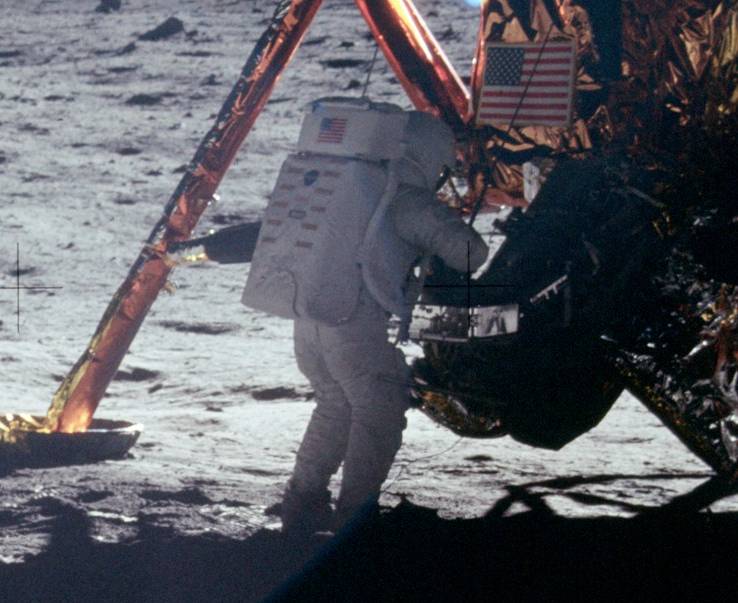
One variant of Progress is a Mission. Here the people set a goal and work hard to make it happen. This could be like Manifest Destiny, when the United States sought to conquer all the land across the continent, from sea to shining sea. It could be like Woodrow Wilson, telling us it’s our job to make the world safe for democracy. Or it could be to be the first country to put a human being on the moon. A Mission, and Progress more generally, lead their people to feel optimism and satisfaction.

Neil Armstrong arrives on the Moon:
Armstrong_on_Moon_(As11-40-5886)_(cropped)

Transformation. Another way to make changes is more abrupt. Here the idea is to sacrifice some of our stability to get somewhere in a hurry. With a Transformation, some people feel joy, while others feel disoriented with the loss of Stability. Some classic examples would be the French Revolution, or Chairman Mao’s Great Leap Forward. Bernie Sanders uses “revolution” language too, although he’s not advocating such an extreme transformation – he wants us to use our existing laws and processes to get America caught up with the rest of the world.

Miracle. The final type of improvement story is when a group reappears and begins to flourish after a disaster – it’s a tragedy with a happy ending. Some Native American writers describe their people’s story that way, like in a film I saw a few years ago, United by Water, where several Pacific Northwest tribes felt their nations had essentially died, until they worked together to reassert themselves. Many Jews felt like this about the forming of the modern nation of Israel. The feelings for a Miracle (or as J.R.R. Tolkien called it, a “eucatastrophe”) are joy and relief.

Prior Fall. We have negative storylines as well. One of the most familiar is the Prior Fall. In this storyline, things were very good for a group of people, but that was lost. We have Adam and Eve, exiled from Eden.

Expelled from Eden:

(c) Walker Art Gallery; Supplied by The Public Catalogue Foundation

(c) Walker Art Gallery; Supplied by The Public Catalogue Foundation

Or we have prehistoric humans, living in harmony with nature, or pre-industrial humans, who had their own harmony with nature. This is an airbrushed look back into the past. It’s not that things were actually better for those early humans, but looking back from the present, those earlier times can feel better – more peaceful, less harmful to the environment.

Specific groups sometimes look back into their past and think things were much better for them then, too. Sometimes they were; at other times, again, they’ve idealized that past. When we compare an ideal past to the present, we may feel shame about the lesser status of our current group. We may feel guilt, if the fall was our fault, and we may feel anger if we think some other group was to blame.

Tragedy. A tragedy is a loss that’s much more fresh. It’s recently happened, and it feels like it’s still ongoing and that nothing can be done. The same shame or guilt or anger still apply, but also frustration. Good examples include when one group takes land away from another, as the U.S. did to its native people, and as the founding of modern Israel did to the people who were already living in Palestine. If a group romanticizes what used to be and what might have been, they can invent their own Tragedy storyline 

Some think the Civil War outcome was a Tragedy:

confederate_flags_charlottesville_from_reddit

Looming Catastrophe. And of course, there’s the negative storyline where the loss is in our future. Climate change is making our weather more extreme, with more hurricanes and wildfires (in fact, one has kept the people of my city indoors for a week now), and in the future it could be much worse. Alternatively, we might be concerned about unchecked immigration or other changes to our communities that could change our way of life. For those attuned to the Looming Catastrophe storyline, the emotions they feel include anxiety, fear, and urgency.

Those are the simple storylines. If we combine them we can get three more genres that are just slightly more complex, but they’re especially powerful.

Crossroads. A Looming Catastrophe implies a crossroads – either we figure out how to stay on our usual course, or everything goes south. But any major decision point is a Crossroads, like if we’re deciding whether to make a significant policy change, or have a revolution, or go to war. One branch takes us on one storyline, and the other takes us elsewhere. Emotions at a Crossroads include anticipation, anxiety, and whatever else may be associated with each of the two paths, as well as a sense that the time we live in is important and meaningful.

Restoration. If we combine a Prior Fall that takes us from an idealized past to a degraded present, with a Transformation that lifts us back to that ideal state again, then we have a Restoration. This storyline may be extra-powerful because it fits the conventional story prototype, in which things are okay, but then some problem arises, which has to be fixed to yield a resolution.

The Restoration storyline is the basis for Christianity – humanity lived in Eden, but they fell from grace, and now we live in a sinful world, but believers can hope to go to heaven. It’s also the basis for nationalism – a people have a wonderful mythic past, but they were conquered or dominated by others, and they want their sovereignty restored so they can achieve their rightful place in the world.

The Restoration storyline combines all the emotions of its underlying components, and it often also comes with an extra sense of drama, even melodrama, especially if you add in a Crossroads and danger, like conflict with another group or some other pending disaster.

Triumph. Finally, we have the storyline that comes from combining achievement, as in Progress or Transformation or Restoration, with permanent Stability thereafter, resulting in feelings of pride, security, and confidence. This storyline also uses basic narrative psychology, with a period of suspense that is resolved, just like when you read a book or watch a movie and at the end expect closure, our happily ever after. Or, as some might say, our “Final Solution” – the Holocaust was intended to fit this genre.

Once we’ve achieved a Triumph, we’re extra-motivated to keep its stability. A modern example comes from our own recent history – after the Cold War, the United States was quite satisfied to find itself the “lone superpower.” Its expectation that it now had everything under control was thoroughly dispelled by the 9/11 terrorist attacks, which were extra shocking because the U.S. thought it had already reached closure on its role in the world.

So there we have it, twelve “super-stories” and a few variants – emotional genres for meta-narratives. This list is certainly not exhaustive; it just illustrates many we’re familiar with today. At other times and places, people might understand their group’s history very differently. For example, time doesn’t even necessarily move forward! Mircea Eliade, a famous scholar of religions, describes societies where religious practices allow people to experience mythic times from the distant past, an Eternal Return. With a meta-narrative like that, the world is experienced as endless cycles – very much like in Robert Jordan’s Wheel of Time fantasy series. Others sometimes describe our progress, catastrophes, and so on as stages in much larger eras, beyond the scope of human lifetimes, but if we think in those terms we may tend to feel dwarfed by inevitabilities beyond our control. We might just give up.

The next time you hear a leader telling you about their vision for the future, see if you can recognize one or more of these stories. And then decide for yourself. Does it fit the facts? And is it fair, not just to the group telling the story, but to the other groups appearing in the story? If not, how would you tell the story differently? If you had the chance, what would you say to your fellow citizens?

*   *   *

I’m writing a book on this topic, and I could use your help. An important part of the publishing process these days is for the author to be able to show the publishers that people are interested in their work. If you enjoyed this post, please “like” it and share it on social media. If you’d like to read future posts, please “Follow” by entering your e-mail address at the top of the right-hand column. Both of those steps will help me show the publishing world that people are listening. Thank you!

Posted in narrative science | Tagged , , | 11 Comments

What if half the country’s in a cult (and doesn’t know it)?

How can you tell if you’ve accidentally signed up for a cult? One sign is that you’re so enthusiastically opposed to the U.S. presidential candidates besides the one you prefer that you’re no longer living up to the “reflective” ideal I described in my last post.

Of course, in a democracy, anyone is entitled to limit their point of view and ignore the rest the world has to offer. We can stay inside the “bubbles” or “echo chambers” our friends and media create for us, if we want – in the language of my earlier post, we can be “fully immersed.”

But it’s a slippery slope. It means we trust the authority figures in our “bubble” to do the right thing. And if they know they have that trust, and they’re not actually worthy of that trust, they can get away with murder. So no matter how much we love our candidate, we still need to think for ourselves. Right?

Here’s a quiz! Let’s think about three people who were candidates for president this year: Donald Trump, Joe Biden, and Bernie Sanders.

Positives: Can you list some sincere good sides of each candidate? Here are some examples. Can you think of more?
“Trump hasn’t gotten us into any wars.”
“Biden is a very good listener.”
“Sanders has done the country a service by raising important issues that we need to address.”

Criticism: How do you feel about critiquing your preferred candidate? Is it important to critique them, or does it feel disloyal?

Perspectives: When you see media for another perspective, do you always brush it off in horror or disdain, or do you sometimes find yourself thinking, “They may have a point”? If so, would you admit to that in public?

Values: Do your own values stay the same no matter who’s in office? For example, if you believe family values are important and you’re otherwise a Trump fan, do you find yourself saying, “I admire Obama’s commitment to marriage and family, and it bothers me that Trump’s personal life has a poor track record in that regard”?

Loyalty: What do you think is more important, loyalty to your candidate or loyalty to values that would lead you to reject your candidate if they cross a line?

Methods: What do you think is more important, for your candidate to pursue their goals using whatever methods they think will be best or most effective, or for your candidate to respect the Constitution?

Anxiety: Do you see your candidate as someone who would save us from a terrible fate… other than whatever terrible fates might befall us as a result of electing one of the other candidates?

Variety: Do you think it would be better for the country to always have the same political party in power?

Term Limits: If your candidate were elected president, would you favor removing the term limits so they could stay in power longer than the Constitution currently allows?

Accountability: If your candidate were elected president, who should they be accountable to – the American people, or only their own conscience?

Respect: 
If you favor Biden or Sanders, list three positive things you sincerely admire about George W. Bush – things Republicans would generally agree with you about.
If you favor Trump, list three positive things you sincerely admire about Barack Obama – things Democrats would generally agree with you about.

The other side: When thinking about the Americans you disagree with, which would be better – to understand their needs so your own party can better meet them, or for them to just shut up or leave the country?

Excitement: Are you only willing to vote for president if a candidate who excites you is on the ballot?

Heroism: Have you ever described your favored candidate as a hero?

Higher powers: Have you ever described your favored candidate as divinely chosen or favored by God?

I’m not going to score your answers. For one thing, that would imply I’d spent months doing surveys and analyses to find out where each of these questions lies on the spectrum of “thinking for ourselves” versus “being in a cult.” That’s not the point here; this is not scientific research. My point is to encourage each one of us to do some soul searching.

What do you think? What would you add to my quiz?

*    *    *

I’m writing a book, and I could use your help. An important part of the publishing process these days is for the author to be able to show the publishers that people are interested in their work. If you enjoyed this post, please “like” it and share it on social media. If you’d like to read future posts, please “Follow” by entering your e-mail address at the top of the right-hand column. Both of those steps will help me show the publishing world that people are listening. Thank you!

Posted in Uncategorized | 1 Comment